Quotessence
Home / Quotes / Quote by Aristotle

Quote by Aristotle

Work

The Nicomachean ethics

Written by Aristotle, The Nicomachean Ethics is a comprehensive treatise on ethics that delves into the nature of virtue, the role of habituation, and the importance of practical wisdom. It is considered one of the most significant texts in the history of philosophy, offering insights into moral character and the pursuit of eudaimonia, or human flourishing. more

Author
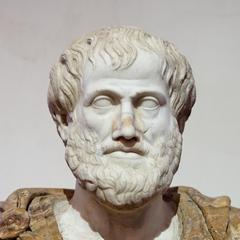
Aristotle
Aristotle

Aristotle, a renowned Greek philosopher, is one of the founders of Western philosophy. His thoughts covered a wide range of fields, including ethics, logic, politics, and had a profound impact on the world. more

You May Also Like

“Those who merely possess the goods of fortune may be haughty and insolent; . . . they try to imitate the great-souled man without being really like him, and only copy him in what they can, reproducing his contempt for others but not his virtuous conduct. For the great-souled man is justified in despising other people - his estimates are correct; but most proud men have no good ground for their pride.”

“All are agreed that the various moral qualities are in a sense bestowed by nature: we are just, and capable of temperance, and brave, and possessed of the other virtues from the moment of our birth. But nevertheless we expect to find that true goodness is something different, and that the virtues in the true sense come to belong to us in another way. For even children and wild animals possess the natural dispositions, yet without Intelligence these may manifestly be harmful.”

“All men, or most men, wish what is noble but choose what is profitable; and while it is noble to render a service not with an eye to receiving one in return, it is profitable to receive one. One ought therefore, if one can, to return the equivalent of services received, and to do so willingly; for one ought not to make a man one's friend if one is unwilling to return his favors.”

“Nor need it cause surprise that things disagreeable to the good man should seem pleasant to some men; for mankind is liable to many corruptions and diseases, and the things in question are not really pleasant, but only pleasant to these particular persons, who are in a condition to think them so.”

“Also our fellow competitors, who are indeed the people just mentioned - we do not compete with men who lived a hundred centuries ago, or those yet not born, or the dead, or those who dwell near the Pillars of Hercules, or those whom, in our opinion or that of others, we take to be far below us or far above us. So too we compete with those who follow the same ends as ourselves; we compete with our rivals in sport or in love, and generally with those who are after the same things; and it is therefore these whom we are bound to envy beyond all others. Hence the saying.”