Quotessence
Home / Quotes / Quote by Friedrich Engels

Quote by Friedrich Engels

“From the moment when the bourgeois demand for the abolition of class privileges was put forward, alongside it appeared the proletarian demand for the abolition of the classes themselves. [...] The proletarians took the bourgeoisie at its word: equality must not be merely apparent, must not apply merely to the sphere of the state, but must also be real, must also be extended to the social, economic sphere. [...] Any demand for equality which goes beyond that, of necessity passes into absurdity.”

Quote by Friedrich Engels

Work

Anti-Dühring: Herr Eugen Dühring’s Revolution in Science

Browse quotes and source details for this work. more

Author
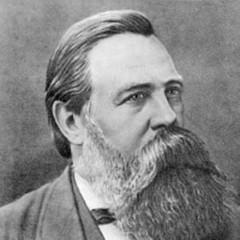
Friedrich Engels
Friedrich Engels

Friedrich Engels was a German philosopher, politician, economist, and revolutionary, co-founder of communist theory with Karl Marx. He was born on November 28, 1820, and died on August 5, 1895. more

You May Also Like

“Marx and Engels, in their giddy enthusiasm for the industrial revolutions of their day, [...] were wrong to predict that market competition would compel factory owners to-go on with mechanization anyway. If it didn't happen, it can only be because market competition is not, in fact, as essential to the nature of capitalism as they had assumed. If nothing else, the current form of capitalism, where much of the competition seems to take the form of internal marketing within the bureaucratic structures of large semi-monopolistic enterprises, would presumably have come as a complete surprise to them.”

“Every chemical compound, according to Engels, comes into existence only at a certain time in the development of the universe when the conditions are appropriate for it; and when it does come into existence it manifests this by entering into its characteristic relations. Neither carbon compounds or proteins are ideal forms, but are themselves witnesses of the conditions on a cooling planet. It is here that occurs his celebrated remark that life is the mode of existence of proteins.”

“In the same year as the original Disaster article, Meredeth Turshen attacked the paradigm of clinical medicine as excessively preoccupied with how the individual body reacts to disease, missing the bigger picture of class and other collectivities. She cited Engels’s descriptions of how polluted air, poorly ventilated houses, overcrowded slums and omnipresent sewage predisposed the workers of Manchester to become ill. She could have also quoted Rosa Luxemburg: ‘The doctors can trace the fatal infection in the intestines of the poisoned victims as long as they look through their microscopes; but the real germ which caused the death of the people in the asylum is called – capitalist society, in its purest culture.’ Since the 1970s, critical epidemiology has agreed with critical vulnerability theory on emphasising the social over the natural: disease and disaster as produced through processes internal to society.”