Quotessence
Home / Quotes / Quote by Bertolt Brecht

Quote by Bertolt Brecht

“Ah, we've had so many masters, Swine or eagle, lean or fat one: Some were tiers, some hyenas, Still we fed this one and that one. Whether one is better than the other: Ah, one boot is always like another When it treads upon you. What I say about them Is we need no other masters: we can do without them! Yes, the wheel is always turning madly, Neither side stays up or down, But the water underneath fares badly For it has to make the wheel go round. (Ach, wir hatten viele Herren Hatten Tiger und Hyänen Hatten Adler, hatten Schweine Doch wir nährten den und jenen. Ob sie besser waren oder schlimmer: Ach, der Stiefel glich dem Stiefel immer Und uns trat er. Ihr versteht, ich meine Dass wir keine andern Herren brauchen, sondern keine! Freilich dreht das Rad sich immer weiter Dass, was oben ist, nicht oben bleibt. Aber für das Wasser unten heisst das leider NurL dass es das Rad halt ewig treibt.)”

Quote by Bertolt Brecht

Work

Author

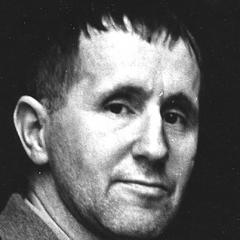
Bertolt Brecht
Bertolt Brecht

Bertolt Brecht, born on February 10, 1898, and died on August 14, 1956, was a German poet, playwright, director, and theorist. He is considered one of the most important theater reformers of the 20th century, whose innovative theatrical theories and practices have had a profound impact on world theater. more

You May Also Like

“If you tour any workplace, you will see countless logos and banners paying lip service to freedom of speech, democracy, logos like ‘speak up, speak out’, creativity, innovation, and on and on goes the list of flashy words and adjectives that companies and corporations want their employees (and outsiders) to believe are part of their work ethics and culture. Yet, most employees learn at the earliest stages of their careers that these bogus adjectives will get them fired, if they are naïve enough to believe in – let alone act on – them.”

“You could say that cleaning someone else’s house was a shit job. That it was disgusting to be entangled in someone else’s habits and ways, finding nail clippings—finger and toe—and little fluffy hair nests and partly squeezed tubes of cortisone cream or even lube, all of it evidence of a life you really didn’t want to think about. But you could also just say that it was work. And that work was admirable, even if it was hard or unappealing or undersung, or often maddeningly underpaid if you were female, as Greer used to remind him.”

“The people I love the best jump into work head first without dallying in the shallows and swim off with sure strokes almost out of sight. They seem to become natives of that element, the black sleek heads of seals bouncing like half-submerged balls. I love people who harness themselves, an ox to a heavy cart, who pull like water buffalo, with massive patience, who strain in the mud and the muck to move things forward, who do what has to be done, again and again. I want to be with people who submerge in the task, who go into the fields to harvest and work in a row and pass the bags along, who are not parlor generals and field deserters but move in a common rhythm when the food must come in or the fire be put out. The work of the world is common as mud. Botched, it smears the hands, crumbles to dust. But the thing worth doing well done has a shape that satisfies, clean and evident. Greek amphoras for wine or oil, Hopi vases that held corn, are put in museums but you know they were made to be used. The pitcher cries for water to carry and a person for work that is real.”

“Av jord var de kommet, til jord skulle de bli, og i de få årene livet levde i dem, var det fra jorden det hentet sin kraft. Den eneste veien ut av det, var lenger inn i det. Lavt er pliktens himmel hvelvet, men det er en himmel. Under den gikk Lamek, og der fant han sin mening. Denne meningen hadde en fiende, det var lengselen etter noe annet, og den bekjempet han med det eneste middelet han kjente: mer arbeid. Arbeidet var således både flukten, og det han flyktet fra.”

“In reality, in most American companies, only few handpicked—arguably appointed— individuals in powerful positions; positions like leadership, finance, treasury, advisory, and so on, have the last say in what matters. Their words, no matter how nonsensical, are treated as the ultimate wisdom. Their silences are emulated by everyone else working under them, regardless of any human, capital, or ethical costs resulting from such silences. These powerful individuals are often so emotionally and intellectually abusive that employees treat even their most absurd suggestions as roadmaps dictating the direction of any company or project at hand.”