“In sovereignty there are no gradations.”
Quote by Samuel Johnson
Work
Sir Robert Chambers: Law, Literature, and Empire in the Age of Johnson
Sir Robert Chambers: Law, Literature, and Empire in the Age of Johnson is a scholarly study that delves into the multifaceted career of Sir Robert Chambers. The book investigates his legal writings, his influence on literature, and his involvement in the expansion of the British Empire. It provides an in-depth analysis of Chambers' work and its historical context, offering readers a comprehensive understanding of his impact on the 18th-century intellectual and political landscape. more
Author
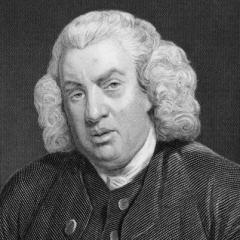
Samuel Johnson
Samuel Johnson was an English writer, poet, and lexicographer, renowned for his comprehensive English dictionary, 'A Dictionary of the English Language', published in 1755. His distinctive writing style and wit have cemented his place as a significant figure in the history of English literature. more
You May Also Like
“See nations slowly wise, and meanly just, to buried merit raise the tardy bust.”
Source: Selected poetry and prose
“The whole world is put in motion by the wish for riches and the dread of poverty.”
Source: The Rambler: In Four Volumes
“Rash oaths, whether kept or broken, frequently produce guilt.”
Source: The Beauties of Samuel Johnson, LL.D.: Consisting of Maxims and Observations, Moral, Critical, and Miscellaneous, to which are Now Added, Biographical Anecdotes of the Doctor, Selected from the Late Productions of Mrs. Piozzi, Mr. Boswell, ...
Source: Selected essays
Source: Rasselas
“Instead of rating the man by his performances, we rate too frequently the performances by the man.”
Source: The Rambler: In Four Volumes
Source: The Works of Samuel Johnson, L. L. D.: In Twelve Volumes
Source: The Works of Samuel Johnson, LL.D..: The Rambler