Quotessence
Home / Quotes / Quote by Karel Capek

Quote by Karel Capek

“I think I am slowly becoming an anarchist, that this is only another label for my privateness, and I think that you will understand this in the sense of being against collectivity.”

Quote by Karel Capek

Author
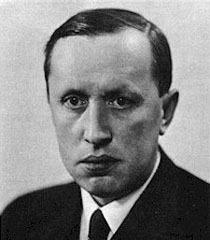
Karel Capek
Karel Capek

Karel Capek was a renowned Czech writer born on January 9, 1890, and died on December 25, 1938. He is best known for his science fiction novel 'R.U.R. – Rossum's Universal Robots,' which had a profound impact on the development of science fiction literature. more

You May Also Like

“All too willingly man sees himself as the centre of the universe, as something not belonging to the rest of nature but standing apart as a different and higher being. Many people cling to this error and remain deaf to the wisest command ever given by a sage, the famous "Know thyself" inscribed in the temple of Delphi.”

“The attitude of the true scientist towards the real limits of human understanding was unforgettably impressed on me in early youth by the obviously unpremeditated words of a great biologist; Alfred Kuhn finished a lecture to the Austrian Academy of Science with Goethe 's words, "It is the greatest joy of the man of thought to have explored the explorable and then calmly to revere the inexplorable." After the last word he hesitated, raised his hand in repudiation and cried, above the applause, "No, not calmly, gentlemen; not calmly!”

“Nothing can better express the feelings of the scientist towards the great unity of the laws of nature than in Immanuel Kant's words: "Two things fill the mind with ever new and increasing awe: the stars above me and the moral law within me."... Would he, who did not yet know of the evolution of the world of organisms, be shocked that we consider the moral law within us not as something given, a priori, but as something which has arisen by natural evolution, just like the laws of the heavens?”

“(The processes are) doubly ruinous: they impoverish the earth by hastily removing, for the benefit of a few generations, the common resources which, once expended and dissipated, can never be restored; and second, in its technique, its habits, its processes, the paleotechnic period is equally inimical to the earth considered as a human habitat, by its destruction of the beauty of the landscape, its ruining of streams, its pollution of drinking water, its filling the air with a finely divided carboniferous deposit, which chokes both life and vegetation.”