Quotessence
Home / Quotes / Quote by Alexandre Dumas

Quote by Alexandre Dumas

Author

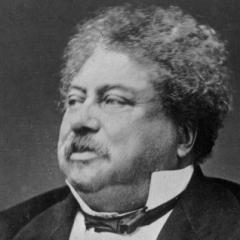
Alexandre Dumas
Alexandre Dumas

Alexandre Dumas, a renowned French writer, was born on July 24, 1802, and died on December 5, 1870. He is famous for his historical and adventure novels, with notable works including 'The Three Musketeers' and 'The Count of Monte Cristo'. more

You May Also Like

“Time will break all of the old habits and create new ones for you, and in the process, you will try to handle this immense pain with dignity (because you're that kind of girl). You actually will have to move on and you actually will be fine and that's when he may actually miss how incredible and special you are.”

“The greatest wisdom is to make the enjoyment of the present the supreme object of life; because that is the only reality, all else being merely the play of thought. On the other hand, such a course might just as well be called the greatest folly: for that which in the next moment exists no more, and vanishes utterly, like a dream, can never be worth a serious effort.”

“A man never is happy, but spends his whole life in striving after something which he thinks will make him so; he seldom attains his goal, and when he does, it is only to be disappointed; he is mostly shipwrecked in the end, and comes into harbor with mast and rigging gone. And then, it is all one whether he has been happy or miserable; for his life was never anything more than a present moment always vanishing; and now it is over.”

“If the lives of men were relieved of all need, hardship and adversity; if everything they took in hand were successful, they would be so swollen with arrogance that, though they might not burst, they would present the spectacle of unbridled folly-nay, they would go mad. And I may say, further, that a certain amount of care or pain or trouble is necessary for every man at all times. A ship without ballast is unstable and will not go straight.”

“He who lives to see two or three generations is like a man who sits some time in the conjurer's booth at a fair, and witnesses the performance twice or thrice in succession. The tricks were meant to be seen only once; and when they are no longer a novelty and cease to deceive, their effect is gone.”

“In order to increase his pleasures, man has intentionally added to the number and pressure of his needs, which in their original state were not much more difficult to satisfy than those of the brute. Hence luxury in all its forms; delicate food, the use of tobacco and opium, spirituous liquors, fine clothes, and the thousand and one things that he considers necessary to his existence.”