Quotessence
Home / Quotes / Quote by Arthur Conan Doyle

Quote by Arthur Conan Doyle

Work

The Naval Treaty - a Sherlock Holmes Short Story

Browse quotes and source details for this work. more

Author
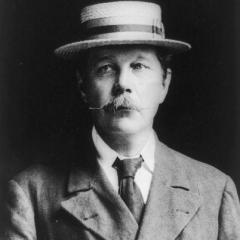
Arthur Conan Doyle
Arthur Conan Doyle

Arthur Conan Doyle, born on May 22, 1859 in Edinburgh, Scotland, was a renowned Scottish physician and writer. He is best known for his creation of the Sherlock Holmes series of detective novels, which have had a profound impact on the development of detective fiction and played a crucial role in shaping modern detective culture. more

You May Also Like

“There was real plasure to be had eating ice cream out of container and pickles out of a glass jar, standing up at the counter. I wondered whether the cravings associated with pregnancy were really only a matter of women feeling empowered to admit their odd longings to their husbands, to ask another person to bring them the eccentric combinations they'd long enjoyed in private.”

“A sampler of England's hottest 'chefs' would include a mostly hairless young blond lad named Jamie Oliver, who is referred to as the Naked Chef. As best as I can comprehend, he's a really rich guy who pretends he scoots around on a Vespa, hangs out in some East End cold-water flat, and cooks green curry for his 'mates'. He's a TV chef, so few actually eat his food. I've never seen him naked. I believe the 'Naked' refers to his 'simple, straightforward, unadorned' food; though I gather that a great number of matronly housewives would like to believe otherwise. Every time I watch his show, I want to go back in time and bully him at school.”

“Eating is an agricultural act,' as Wendell Berry famously said. It is also an ecological act, and a political act, too. Though much has been done to obscure this simple fact, how and what we eat determines to a great extent the use we make of the world - and what is to become of it. To eat with a fuller consciousness of all that is at stake might sound like a burden, but in practice few things in life can afford quite as much satisfaction. By comparison, the pleasures of eating industrially, which is to say eating in ignorance, are fleeting. Many people today seem erfectly content eating at the end of an industrial food chain, without a thought in the world; this book is probably not for them.”

“There are very few men and women, I suspect, who cooked and marketed their way through the past war without losing forever some of the nonchalant extravagance of the Twenties. They will feel, until their final days on earth, a kind of culinary caution: butter, no matter how unlimited, is a precious substance not lightly to be wasted; meats, too, and eggs, and all the far-brought spices of the world, take on a new significance, having once been so rare. And that is good, for there can be no more shameful carelessness than with the food we eat for life itself When we exist without thought or thanksgiving we are not men, but beasts.”