Quotessence
Home / Quotes / Quote by Karl Marx

Quote by Karl Marx

“The specific economic form, in which unpaid surplus-labour is pumped out of direct producers, determines the relationship of rulers and ruled, as it grows directly out of production itself and, in turn, reacts upon it as a determining element. Upon this, however, is founded the entire formation of the economic community which grows up out of the production relations themselves, thereby simultaneously its specific political form. It is always the direct relationship of the owners of the conditions of production to the direct producers — a relation always naturally corresponding to a definite stage in the development of the methods of labour and thereby its social productivity — which reveals the innermost secret, the hidden basis of the entire social structure and with it the political form of the relation of sovereignty and dependence, in short, the corresponding specific form of the state. This does not prevent the same economic basis — the same from the standpoint of its main conditions — due to innumerable different empirical circumstances, natural environment, racial relations, external historical influences, etc. from showing infinite variations and gradations in appearance, which can be ascertained only by analysis of the empirically given circumstances.”

Quote by Karl Marx

Work

Capital: A Critique of Political Economy, Volume 3

Browse quotes and source details for this work. more

Author
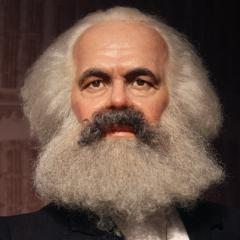
Karl Marx
Karl Marx

Karl Marx (May 5, 1818 - March 14, 1883) was a German philosopher, economist, sociologist, political theorist, and revolutionary. He is one of the founders of Marxism and his works, including 'Das Kapital' and 'The Communist Manifesto', have had a profound impact on the world. more

You May Also Like

“The class struggle, which is always present to a historian influenced by Marx, is a fight for the crude and material things without which no refined and spiritual things could exist. Nevertheless, it is not in the form of the spoils which fall to the victor that the latter make their presence felt in the class struggle. They manifest themselves in this struggle as courage, humor, cunning, and fortitude. They have retroactive force and will constantly call in question every victory, past and present, of the rulers. As flowers turn toward the sun, by dint of a secret heliotropism the past strives to turn toward that sun which is rising in the sky of history. A historical materialist must be aware of this most inconspicuous of all transformations.”

“In studying such transformations it is always necessary to distinguish between the material transformation of the economic conditions of production, which can be determined with the precision of natural science, and the legal, political, religious, artistic or philosophic – in short, ideological forms in which men become conscious of this conflict and fight it out. Just as one does not judge an individual by what he thinks about himself, so one cannot judge such a period of transformation by its consciousness, but, on the contrary, this consciousness must be explained from the contradictions of material life, from the conflict existing between the social forces of production and the relations of production. No social order is ever destroyed before all the productive forces for which it is sufficient have been developed, and new superior relations of production never replace older ones before the material conditions for their existence have matured within the framework of the old society.”

“The uninterrupted victory of democracy, which to our revisionism as well as to bourgeois liberalism, appears as a great fundamental law of human history and, especially, modern history has shown upon closer examination to be a phantom. No absolute and general relation can be constructed between capitalist development and democracy. The political form of a given country is always the result of the composite of all the existing political factors, domestic as well as foreign. It admits within its limits all variations of the scale from absolute monarchy to the democratic republic.”

“At the present time, it is of course still impossible to foresee to any precise degree just what sections of the field of history will be illuminated and just how much light will be cast by a materialist investigation which would proceed from a more concrete study of the capitalist curve and the interrelationship between the latter and all the aspects of social life. Conquests that may be attained on this road can be determined only as the result of such an investigation itself, which must be more systematic, more orderly than those historical materialist excursions hitherto undertaken. In any case, such an approach to modern history promises to enrich the theory of historical materialism with conquests far more precious than the extremely dubious speculative juggling with the concepts and terms of the materialist method that has, under the pens of some of our Marxists, transplanted the methods of formalism into the domain of the materialist dialectic, and has led to reducing the task to rendering definitions and classifications more precise and to splitting empty abstractions into four equally empty parts; it has, in short, adulterated Marxism by means of the indecently elegant mannerisms of Kantian epigones. It is a silly thing indeed endlessly to sharpen and resharpen an instrument to chip away Marxist steel, when the task is to apply the instrument in working over the raw material!”

“Politics always lags behind economics, far behind. The state apparatus is far more resistant than is possible to believe; and it succeeds, at moments of crisis, in organizing greater forces loyal to the regime than the depth of the crisis might lead one to suppose. This is especially true of the more important capitalist states.”

“Your future should be more than just proving others wrong. Your why and your lighthouse must be specific to you and developed from your life, your situation, your deep-rooted hunger, your past, your pain, your fears, and who you are built to be.”