Quotessence
Home / Quotes / Quote by Joseph Stalin

Quote by Joseph Stalin

“The present system is a capitalist system. This means that the world is divided up into two antagonistic camps, the camp of a small handful of capitalists and the camp of the majority - the proletarians. The proletarians work day and night, nevertheless they remain poor. The capitalists do not work, nevertheless they are rich. This takes place not because the proletarians are unintelligent and the capitalists are geniuses, but because the capitalists appropriate the fruit of the labour of the proletarians, because the capitalists exploit the proletarians. Why is the fruit of the labour of the proletarians appropriated by the capitalists and not by the proletarians? Why do the capitalists exploit the proletarians and not vice versa? Because the capitalist system is based on commodity production: here everything assumes the form of a commodity, everywhere the principle of buying and selling prevails. Here you can buy not only articles of consumption, not only food products, but also the labour power of men, their blood and their consciousness. The capitalists know all of this and purchase the labour power of the proletarians, they hire them. This means the capitalists become the owners of the labour power they buy. The proletarians, however, lose their right to the labour power which they have sold. That is to say, what is produced by that labour power no longer belongs to the proletarians, it belongs only to the capitalists and goes into their pockets. The labour power which you have sold may produce in the course of a day, goods to the value of 100 rubles, but that is not your business, those goods do not belong to you, it is the business only of the capitalists, and the goods belong to them - all that you must receive is your daily wage which, perhaps, may be sufficient to satisfy your essential needs if, of course, you live frugally.”

Quote by Joseph Stalin

Work

Anarchism or Socialism?

Browse quotes and source details for this work. more

Author
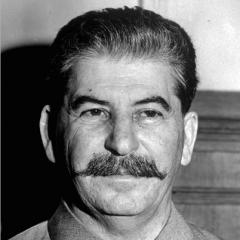
Joseph Stalin
Joseph Stalin

Joseph Stalin, the former Premier of the Soviet Union, was born on December 18, 1878, and died on March 5, 1953. He was the leader of the Soviet Communist Party and had a profound impact on the political, economic, and military development of the Soviet Union. more

You May Also Like

“Although fascism rallies to the defense of the main points of bourgeois ideology which has become conservative (the family, property, the moral order, the nation), reuniting the petty-bourgeoisie and the unemployed routed by crisis or deceived by the impotence of socialist revolution, it is not itself fundamentally ideological. It presents itself as it is: a violent resurrection of myth which demands participation in a community defined by archaic pseudo-values: race, blood, the leader. Fascism is technically-equipped archaism. Its decomposed ersatz of myth is revived in the spectacular context of the most modern means of conditioning and illusion. Thus it is one of the factors in the formation of the modern spectacle, and its role in the destruction of the old workers’ movement makes it one of the fundamental forces of present-day society.”

“In fact, this can happen only when the conditions for commodity production and exchange are equal for all members of society; that is to say, when they are all independent owners of their means of production who use these means to fabricate the product and exchange it on the market. This is the most elementary relationship, and constitutes the starting point for a theoretical analysis. Only on this basis can later modifications be understood; but they must always satisfy the condition that, whatever the nature of an individual exchange may be, the sum of exchange acts must clear the market of the total product. Any modification can be induced only by a change in the position of the members of society within production. In fact, the modification must take place in this manner because production and the producers can only be integrated as a social unit through the operation of the exchange process. Thus the expropriation of one section of society and the monopolization of the means of production by another modify the exchange process, because only there can the fact of social inequality appear. However, since the exchange relationship is one of equality, social inequality must assume the form of a parity of prices of production rather than an equality of value. In other words, the inequality in the expenditure of labour (which is a matter of indifference to capitalists since it is the labour expenditure of others) is concealed behind an equalization of the rate of profit. This kind of equality simply underlines the fact that capital is the decisive factor in a capitalist society. The individual act of exchange no longer has to satisfy the requirement that units of labour in exchange shall be equal, and instead the principle now prevails that equal profits shall accrue to equal capitals. The equalization of labour is replaced by the equalization of profit, and products are sold not at their values, but at their prices of production.”

“The ripe, the golden month has come again, and in Virginia the chinkapins are falling. Frost sharps the middle music of the seasons, and all things living on the earth turn home again... the fields are cut, the granaries are full, the bins are loaded to the brim with fatness, and from the cider-press the rich brown oozings of the York Imperials run. The bee bores to the belly of the grape, the fly gets old and fat and blue, he buzzes loud, crawls slow, creeps heavily to death on sill and ceiling, the sun goes down in blood and pollen across the bronzed and mown fields of the old October.”

“Oh come now," Bast reproached, his smile falling away. "That's just insulting." "By earth and stone, I abjure you!" Kote dipped his fingers into the cup by his side and flicked droplets casually in Bast's direction. "Glamour be banished!" "With cider?" Bast managed to look amused and annoyed at the same time as he daubed a bead of liquid from the front of his shirt. "This better not stain.”

“Isaac took a long swig from the unmarked bottle. He'd tasted her cider before, but this bottle was completely different, yet just as wonderful. The apple was more prominent, yet not sweet, almost funky but in a good, blue-cheese way. He held the bottle up to the light and could see the sediment swirling in the bottom. "This is amazing- so different from the other one." Sanna grinned. "You really like Olive? I wasn't sure when I blended it. Not everyone likes the murkiness." "Olive?" Sanna leaned against the counter, putting her weight on her wrist as she studied him for a long moment, her eyes squinting. She took a long drink from her own bottle. "I see colors when I make ciders. I can't explain it. Each juice has its own hue. That's what those paintings represent." She pointed at the watercolors over the fireplace. "A new color comes to me, and I blend the juices until I can re-create it in the flavor. And this one is Olive." "You color-code your ciders?" He struggled to understand what she was telling him. "No." She reached across the counter and pulled her journal toward her. She opened it and handed it to Isaac. As she sipped her cider, he studied the page, then the next page, then the next. On each was a swatch of layered color, all wildly different from one another- reds, greens, teals, colors he didn't really have names for. Next to the colors were measurements, apple varieties, percentages, and flavor notes. Scribbles filled the margins and equations contained both numbers and words. Things like sugars and acidity were measured and tested. It was part recipe book, part coloring book, and part wine label, with a hint of spell book. Looking at it was like opening a tiny door into the back of her head. She saw things that no one else did, an imaginary world of cider only she could see. "You can see the color in your head?" "It's the easiest way to explain it. A color pops into my head, and I know what it will taste like. When I blend the different raw ciders together, I know I have it right when it matches what I've imagined.”

“Yesterday, she had pulled out of the freezer a few special juices from the Looms that she had frozen last fall and set them in the cooler to thaw. When she had pressed them last October, they hadn't produced as much juice as the apples from younger trees, but even the raw juices by themselves were interesting and complex, layers of apple and honey and something earthier. At the time, she'd decided to save them for inspiration to strike. As she had lain in bed, though, waiting for the first rays of light, a color blossomed. A rosy pink, with a hint of coral, bold and opaque. It didn't have any sharp edges. She knew instantly it required juice from one of the Looms. She measured and blended, noting each of the juices she used and in what combination. Two parts Rambo, one part Winesap, a half part Britegold. She sipped it, but the color was too red, almost searing. She needed something to mute it. She walked into the large freezer where she had stored some of the frozen juices and even a few bushels of frozen apples she was experimenting with. She ran her fingers over the giant apple ice cubes in flattened Ziploc bags, closing her eyes and letting the colors emerge- green, periwinkle, sunshine yellow, and a sunset orange.”