Quotessence
Home / Quotes / Quote by Sigmund Freud

Quote by Sigmund Freud

“From what vague signs, for instance, do the young gentlemen of this audience conclude that they have won the favor of a lady? Do you await an explicit declaration, an ardent embrace, or does not a glance, scarcely perceptible to others, a fleeting gesture, the prolonging of a hand-shake by one second, suffice? […] Therefore, let us not undervalue small signs; perhaps by means of them we will succeed in getting on the track of greater things.”

Quote by Sigmund Freud

Work

Introductory Lectures on Psychoanalysis

Browse quotes and source details for this work. more

Author
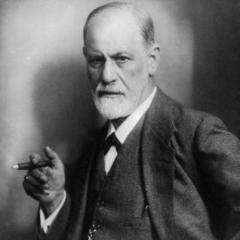
Sigmund Freud
Sigmund Freud

Sigmund Freud, born on May 6, 1856, in Moravia, and died on September 23, 1939, in London, was an Austrian neurologist and the founder of psychoanalysis. Known as the father of modern psychology, Freud made significant contributions to the understanding of human psychology, introducing concepts such as the unconscious mind, dream analysis, and sexual theory. more

You May Also Like

“A person's being in love often furnishes comic, and sometimes even tragic, phenomena, both because, taken possession of by the spirit of the species, he is now ruled by it, and no longer belongs to himself; in this way his conduct becomes inappropriate to the individual. In the higher degrees of being in love, his thoughts are given such a poetical and sublime touch, even a transcendent and hyperphysical tendency, by virtue of which he appears wholly to lose sight of his real, very physical aim.”

“Why, then, does the man in love hang with complete abandon on the eyes of his chosen one, and is ready to make every sacrifice for her? Because it is his immortal part that longs for her; it is always the mortal part alone that longs for everything else. That eager or even ardent longing, directed to a particular woman, is therefore an immediate pledge of the indestructibility of the kernel of our true nature, and of its continued existence in the species. But to regard this continued existence as something trifling and insufficient is a mistake, which arises from the fact that, by the continued life of the species, we understand nothing more than the future existence of beings similar to, but in no respect identical with, ourselves; and this again because, starting from knowledge directed outwards, we take into consideration only the external form of the species, as we apprehend this in perception, and not its inner nature.”

“The connection between evil and Mṛtyu, Death, as well as that between death and desire finally became clear when it was realized that "Death is hunger." This revelation summed up the bond between desire and evil, through Death. Hunger is a desire, but a desire that involves killing, for it makes something disappear. The inevitability of that Evil which is Death was thus found in the first desire to prolong and perpetuate life, which is hunger.”