Quotessence
Home / Quotes / Quote by Norbert Wiener

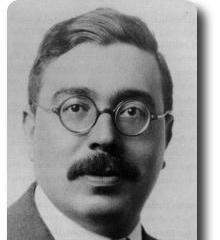
Quote by Norbert Wiener

“Thus the nerve may be taken to be a relay with essentially two states of activity: firing and repose. Leaving aside those neurons which accept their messages from free endings or sensory end organs, each neuron has its message fed into it by other neurons at points of contact known as synapses. For a given outgoing neuron, these vary in number from a very few to many hundred. It is the state of the incoming impulses at the various synapses, combined with the antecedent state of the outgoing neuron itself, which determines whether it will fire or not. If it is neither firing nor refractory, and the number of incoming synapses which “fire” within a certain very short fusion interval of time exceeds a certain threshold, then the neuron will fire after a known, fairly constant synaptic delay. This is perhaps an oversimplification of the picture: the “threshold” may not depend simply on the number of synapses but on their “weight” and their geometrical relations to one another with respect to the neuron into which they feed; and there is very convincing evidence that there exist synapses of a different nature, the so-called “inhibitory synapses,” which either completely prevent the firing of the outgoing neuron or at any rate raise its threshold with respect to stimulation at the ordinary synapses. What is pretty clear, however, is that some definite combinations of impulses on the incoming neurons having synaptic connections with a given neuron will cause it to fire, while others will not cause it to fire. This is not to say that there may not be other, non-neuronic influences, perhaps of a humoral nature, which produce slow, secular changes tending to vary that pattern of incoming impulses which is adequate for firing.”

Quote by Norbert Wiener

Work

Author

Norbert Wiener
Norbert Wiener

Norbert Wiener, born on November 26, 1894, and died on March 18, 1964, was an American mathematician and a founding figure in the field of cybernetics. Known as the 'father of the information age,' Wiener made significant contributions to mathematics, physics, and engineering, particularly in the areas of stochastic processes, Fourier analysis, and control theory. more

You May Also Like

“The future’s always perfect. Always know what to say, where to stand, what to do. Can see exactly how things’ll turn out in the future. But I never seen a thing that’s perfect in the future survive perfect when it reaches now. Same for the past. Damn past is like the scraps left over from disasters in the now. Everything’s messed up in the past. Even what works out fine was messed up before it turned out fine. That’s ’cause the past used to be now, you see?”

“The neurons that rested in deep slumber for decades started to fire; now, they are incessant and unstoppable. The faintest spark has set in motion a raging wildfire in my brain taking me back to dreamy places.”

“Our brains contain one hundred billion nerve cells (neurons). Each neuron makes links with ten thousand other neurons to form an incredible three dimensional grid. This grid therefore contains a thousand trillion connections - that's 1,000,000,000,000,000 (a quadrillion). It's hard to imagine this, so let's visualise each connection as a disc that's 1mm thick. Stack up the quadrillion discs on top of each other and they will reach the sun (which is ninety-three million miles from the earth) and back, three times over.”

“I feel as though dispossessed from the semblances of some crystalline reality to which I’d grown accustomed, and to some degree, had engaged in as a participant, but to which I had, nevertheless, grown inexplicably irrelevant. But the elements of this phenomenon are now quickly dissolving from memory and being replaced by reverse-engineered Random Access actualizations of junk code/DNA consciousness, the retro-coded catalysts of rogue cellular activity. The steel meshing titters musically and in its song, I hear a forgotten tale of the Interstitial gaps that form pinpoint vortexes at which fibers (quanta, as it were) of Reason come to a standstill, like light on the edge of a Singularity. The gaps, along their ridges, seasonally infected by the incidental wildfires in the collective unconscious substrata. Heat flanks passageways down the Interstices. Wildfires cluster—spread down the base trunk Axon in a definitive roar: hitting branches, flaring out to Dendrites to give rise to this release of the very chemical seeds through which sentience is begotten. Float about the ether, gliding a gentle current, before skimming down, to a skip over the surface of a sea of deep black with glimmering waves. And then, come to a stop, still inanimate and naked before any trespass into the Field, with all its layers that serve to veil. Plunge downward into the trenches. Swim backwards, upstream, and down through these spiraling jets of bubbles. Plummet past the threshold to trace the living history of shadows back to their source virus. And acquire this sense that the viruses as a sample, all of the outlying populations withstanding: they have their own sense of self-importance, too. Their own religion. And they mine their hosts barren with the utilitarian wherewithal that can only be expected of beings with self-preservationist motives.”

“I hope to inspire you to recognize that your reason for existence is to pursue the things that excite you the most. The best thing you can do--for yourself and everyone else--is to act on the things you're most passionate about. When you do, you'll shine, and everyone else will see that brilliance. On a biological level, the mirror neutrons of the people around you will activate. They will recognize that they can also follow their dreams and accomplish things they have always wanted to accomplish. On a spiritual level, their souls will remember their reason for being.”

“Concepts of memory tend to reflect the technology of the times. Plato and Aristotle saw memories as thoughts inscribed on wax tablets that could be erased easily and used again. These days, we tend to think of memory as a camera or a video recorder, filming, storing, and recycling the vast troves of data we accumulate throughout our lives. In practice, though, every memory we retain depends upon a chain of chemical interactions that connect millions of neurons to one another. Those neurons never touch; instead, they communicate through tiny gaps, or synapses, that surround each of them. Every neuron has branching filaments, called dendrites, that receive chemical signals from other nerve cells and send the information across the synapse to the body of the next cell. The typical human brain has trillions of these connections. When we learn something, chemicals in the brain strengthen the synapses that connect neurons. Long-term memories, built from new proteins, change those synaptic networks constantly; inevitably, some grow weaker and others, as they absorb new information, grow more powerful.”