Quotessence
Home / Quotes / Quote by William Golding

Quote by William Golding

“I had never met the Roman Catholuc Church outside of a history book. To come across it living, so to speak, was like finding a diplodocus.”

Quote by William Golding

Work

The Pyramid

Browse quotes and source details for this work. more
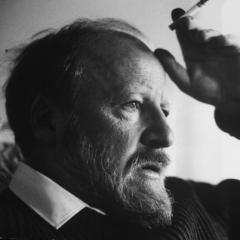
Author

William Golding
William Golding

William Golding was an English novelist, best known for his novel 'Lord of the Flies'. His works often explore themes of human nature, morality, and civilization. more

You May Also Like

“The apostle Paul often appears in Christian thought as the one chiefly responsible for the de-Judaization of the gospel and even for the transmutation of the person of Jesus from a rabbi in the Jewish sense to a divine being in the Greek sense. Such an interpretation of Paul became almost canonical in certain schools of biblical criticism during the nineteenth century, especially that of Ferdinand Christian Baur, who saw the controversy between Paul and Peter as a conflict between the party of Peter, with its 'Judaizing' distortion of the gospel into a new law, and the party of Paul, with its universal vision of the gospel as a message about Jesus for all humanity. Very often, of course, this description of the opposition between Peter and Paul and between law and gospel was cast in the language of the opposition between Roman Catholicism (which traced its succession to Peter as the first pope) and Protestantism (which arose from Luther's interpretation of the epistles of Paul). Luther's favorite among those epistles, the letter to the Romans, became the charter for this supposed declaration of independence from Judaism.”

“Once, during my Catholic days, I was complaining with a Catholic friend about how terrible the teaching was in parish life. A priest listening to us said that everything we griped about was true, but we didn't have to resign ourselves and our children to this fate. 'You could go online to Amazon.com tonight and have sent to you within a week a theological library that Aquinas would have envied,' he said. 'My parents raised me in the seventies, which was the beginning of the catechesis nightmare. They knew that if they were going to raise Catholic kids, they would have to do a lot of it themselves, and they did. So do you.”

“If Roman Catholic Christianity has always struggled with the threat of works righteousness, Reformed Protestantism has always struggled with the threat of cheap grace. For many, if not the majority of Protestants, God's love and acceptance do not lead to personal transformation. Evangelical formation often involves seeking to reestablish a pattern of maturing behaviour that should be integral to one's conversion. So both traditions can be challenged on whether there is a genuinely helpful connection between conversion and transformation.”

“Dialogue with Catholics and other nonevangelical Christians offered some correction to the Church Growth movement's fixation on cultural accommodation and baptism rates. However - save for those few who converted - evangelicals attracted to other Christian traditions have made those traditions their own. They assemble do-it-yourself liturgies from a hodgepodge of monastic prayers and mystics' visions. They lionize medieval dissenters - Celtic monks, or renegade Franciscans - but don't understand their broader Catholic context. Without quite realizing what they have done, evangelicals often use these ancient teachings and practices to confirm, rather than challenge, their own assumptions. History becomes a sidekick to one's twenty-first-century journey with Jesus.”

“I remember that one Holy Week, the magazine I got every Thursday, Anteojito, came with a free poster depicting the Stations of the Cross. I burned the poster and flushed the ashes down the toilet to dispose of the evidence. The idea that I was supposed to pin this graphic depiction of torture and death on my wall seemed to me as obscene as if someone had suggested decorating my room with pictures of the inner workings of Auschwitz.”