Quotessence
Home / Quotes / Quote by Marcel Proust

Quote by Marcel Proust

“A 'real' person, profoundly as we may sympathise with him, is in a great measure perceptible only through our senses, that is to say, he remains opaque, offers a dead weight which our sensibilities have not the strength to lift.”

Quote by Marcel Proust

Work

Swann’s Way

Swann’s Way is a seminal work in modernist literature, renowned for its intricate narrative structure and richly detailed portrayal of human emotions and social interactions. The novel follows the protagonist, Charles Swann, as he navigates the complexities of his personal and social life, reflecting on his relationships, memories, and the passage of time. more
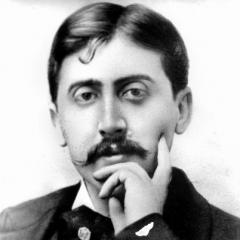
Author

Marcel Proust
Marcel Proust

Marcel Proust was a French novelist renowned for his magnum opus, 'In Search of Lost Time'. This novel is considered a classic of 20th-century literature, known for its intricate psychological portrayals and profound exploration of memory. more

You May Also Like

“Isabelle and Amory were distinctly not innocent, nor were they particularly brazen. Moreover, amateur standing had very little value in the game they were playing, a game that would presumably be her principal study for years to come. She had begun as he had, with good looks and an excitable temperament, and the rest was the result of accessible popular novels and dressing-room conversation culled from a slightly older set. Isabelle had walked with an artificial gait at nine and a half, and when her eyes, wide and starry, proclaimed the ingenue most. Amory was proportionately less deceived. He waited for the mask to drop off, but at the same time he did not question her right to wear it. She, on her part, was not impressed by his studied air of blasé sophistication. She had lived in a larger city and had slightly an advantage in range. But she accepted his pose--it was one of the dozen little conventions of this kind of affair. He was aware that he was getting this particular favor now because she had been coached; he knew that he stood for merely the best game in sight, and that he would have to improve his opportunity before he lost his advantage. So they proceeded with an infinite guile that would have horrified her parents.”

“Amory had rather a Puritan conscience. Not that he yielded to it--later in life he almost completely slew it--but at fifteen it made him consider himself a great deal worse than other boys... unscrupulousness... the desire to influence people in almost every way, even for evil... a certain coldness and lack of affection, amounting sometimes to cruelty... a shifting sense of honor... an unholy selfishness... a puzzled, furtive interest in everything concerning sex. There was, also, a curious strain of weakness running crosswise through his make-up... a harsh phrase from the lips of an older boy (older boys usually detested him) was liable to sweep him off his poise into surly sensitiveness, or timid stupidity... he was a slave to his own moods and he felt that though he was capable of recklessness and audacity, he possessed neither courage, perseverance, nor self-respect. Vanity, tempered with self-suspicion if not self-knowledge, a sense of people as automatons to his will, a desire to "pass" as many boys as possible and get to a vague top of the world... with this background did Amory drift into adolescence.”