Quotessence
Home / Quotes / Quote by Oscar Wilde

Quote by Oscar Wilde

“The artist is the creator of beautiful things. To reveal art and conceal the artist is art's aim. The critic is he who can translate into another manner or a new material his impression of beautiful things. The highest as the lowest form of criticism is a mode of autobiography. Those who find ugly meanings in beautiful things are corrupt without being charming. This is a fault. Those who find beautiful meanings in beautiful things are the cultivated. For these there is hope. They are the elect to whom beautiful things mean only beauty. There is no such thing as a moral or an immoral book. Books are well written, or badly written. That is all. The nineteenth century dislike of realism is the rage of Caliban seeing his own face in a glass. The nineteenth century dislike of romanticism is the rage of Caliban not seeing his own face in a glass. The moral life of man forms part of the subject-matter of the artist, but the morality of art consists in the perfect use of an imperfect medium. No artist desires to prove anything. Even things that are true can be proved. No artist has ethical sympathies. An ethical sympathy in an artist is an unpardonable mannerism of style. No artist is ever morbid. The artist can express everything. Thought and language are to the artist instruments of an art. Vice and virtue are to the artist materials for an art. From the point of view of form, the type of all the arts is the art of the musician. From the point of view of feeling, the actor's craft is the type. All art is at once surface and symbol. Those who go beneath the surface do so at their peril. Those who read the symbol do so at their peril. It is the spectator, and not life, that art really mirrors. Diversity of opinion about a work of art shows that the work is new, complex, and vital. When critics disagree, the artist is in accord with himself. We can forgive a man for making a useful thing as long as he does not admire it. The only excuse for making a useless thing is that one admires it intensely. All art is quite useless.”

Quote by Oscar Wilde

Work

The Picture Of Dorian Gray

The story follows the protagonist Dorian Gray, whose portrait ages while he remains youthful, leading to a dark exploration of the consequences of unchecked desires. more

Author
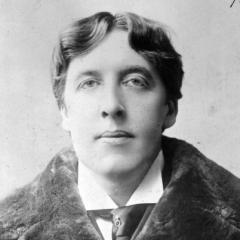
Oscar Wilde
Oscar Wilde

Oscar Wilde, born on October 16, 1854, in Ireland, and died on November 30, 1900, was a renowned Irish writer, playwright, and poet. His works are known for their wit, satire, and unique style, with notable works including 'The Picture of Dorian Gray' and 'Lady Windermere's Fan'. more

You May Also Like

“A work that aspires, however humbly, to the condition of art should carry its justification in every line...To snatch in a moment of courage, from the remorseless rush of time, a passing phase of life is only the beginning of the task. The task approached in tenderness and faith is to hold up unquestioningly, without choice and without fear, the rescued fragment before all eyes and in the light of a sincere mood. It is to show its vibration, its colour, its form; and through its movement, its form, and its colour, reveal the substance of its truth -- disclose its inspiring secret: the stress and passion within the core of each convincing moment. In a single-minded attempt of that kind, if one be deserving and fortunate, one may perchance attain to such clearness of sincerity that at last the presented vision of regret or pity, of terror or mirth, shall awaken in the hearts of the beholders that feeling of unavoidable solidarity; of the solidarity in mysterious origin, in toil, in joy, in hope, in uncertain fate, which binds men to each other and all mankind to the visible world.”

“I sincerely believe that only those who are financially free can produce great works of art. Poor artists are too bothered about money and fame, which hampers their creativity. An artist shouldn’t have any financial pressure. One can’t create something poetic if commercial success is all one is concerned about.”

“Thanks for your encouraging words. But I know the grim realities of being an artist. Most of us would never make a mark in this world. Nearly all of us would be living in oblivion and would face utter neglect by society. You know what? I am prepared for that. It doesn’t matter whether people laud and appreciate my artistic skills or not. Or whether I live a life of non-recognition. I expect nothing. One becomes a true artist only when one creates art just for the sake of it and not for monetary gains or approval from people. I want to become a true artist. Yes, that would give me happiness.”

“Mind thinks in images but, to communicate with another, must transform image into thought and then thought into language. That march, from image to thought to language, is treacherous. Casualties occur: the rich, fleecy texture of image, its extraordinary plasticity and flexibility, its private nostalgic emotional hues - all are lost when image is crammed into language.”

“Most of the world is either asleep or dead. The religious people are, for the most part, asleep. The irreligious are dead. Those who are asleep are divided into two classes, like the Virgins in the parable, waiting for the Bridegroom's coming. The wise have oil in their lamps. That is to say they are detached from themselves and from the cares of the world, and they are full of charity. They are indeed waiting for the Bridegroom, and they desire nothing else but His coming, even though they may fall asleep while waiting for Him to appear. But the others are not only asleep: they are full of other dreams and other desires. Their lamps are empty because they have burned themselves out in the wisdom of the flesh and in their own vanity. When He comes, it is too late for them to buy oil. They light their lamps only after He has gone. So they fall asleep again, with useless lamps, and when they wake up they trim them to investigate, once again, the matters of a dying world.”