Quotessence
Home / Quotes / Quote by John Buchan

Quote by John Buchan

“I have been back among fairy tales,” she says. “I do not quite understand, Alesha. Those gallant little boys! They are youth, and youth is always full of strangeness. Mr. Heritage! He is youth, too, and poetry, perhaps, and a soldier’s tradition. I think I know him... But what about Dickson? He is the petit bourgeois, the épicier, the class which the world ridicules. He is unbelievable. “No,” is the answer. “You will not find him in Russia. He is what they call the middle-class, which we who were foolish used to laugh at. But he is the stuff which aboveall others makes a great people. He will endure when aristocracies crack and proletariats crumble. In our own land we have never known him, but till we create him our land will not be a nation.”

Quote by John Buchan

Work

Huntingtower

Browse quotes and source details for this work. more

Author
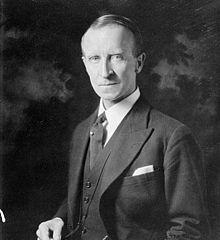
John Buchan
John Buchan

John Buchan, born on August 26, 1875, and died on February 11, 1940, was a former Governor General of Canada and a renowned novelist and historian. He is best known for his historical novels and adventure stories, which have won the hearts of readers worldwide. more

You May Also Like

“What the poor as well as the rich require is not to be indoctrinated, is not to be taught other people’s opinions, but to be induced and enabled to think for themselves. It is not physical science that will do this, even if they could learn it much more thoroughly than they are able to do. After reading, writing, and arithmetic (the last a most important discipline in habits of accuracy and precision, in which they are extremely deficient), the desirable thing for them seems to be the most miscellaneous information, and the most varied exercise of their faculties. They cannot read too much. Quantity is of more importance than quality, especially all reading which relates to human life and the ways of mankind; geography, voyages and travels, manners and customs, and romances, which must tend to awaken their imagination and give them some of the meaning of self-devotion and heroism, in short, to unbrutalise them.”

“A society beset by terrifying social problems was threatened by realism... exacerbated by the deep-seated evils of poverty and overcrowding generated by Scotland's pell-mell industrialisation. To expose these would be revolutionary; it would also break the discipline of puritanism by mentioning the unmentionable... The Kirk enforced silence out of conviction, the middle class out of fear. The bogus community of the Kailyard was an alternative to the horror of the real thing.”

“Wilson was the clay-footed prophet of the British-Scots middle class. He created a flatulent rhetoric of national feeling as an antidote to either true national cosciousness or will. He exploited nationalism and religion in order to pursue class politics.”

“The feudal ownership of land did bring dignity, whereas the modern ownership of movables is reducing us again to a nomadic horde. We are reverting to the civilisation of luggage, and historians of the future will note how the middle classes accreted possessions without taking root in the earth, and may find in this the secret of their imaginative poverty. The Schlegels were certainly the poorer for the loss of Wickham Place. It had helped to balance their lives, and almost to counsel them. Nor is their ground-landlord spiritually the richer. He has built flats on its site, his motor-cars grow swifter, his exposures of Socialism more trenchant. But he has spilt the precious distillation of the years, and no chemistry of his can give it back to society again.”

“Built up by the middle classes to hold their own against royalty, sanctioning, and, at the same time strengthening, their sway over the workers, parliamentary rule is pre-eminently a middle-class rule. The upholders of this system have never seriously maintained that a parliament or a municipal council represent a nation or a city. The most intelligent among them know that this is impossible. The middle classes have simply used the parliamentary system to raise a protecting barrier against the pretensions of royalty, without giving the people liberty. But gradually, as the people become conscious of their real interests, and the variety of their interests is growing, the system can no longer work. Therefore democrats of all countries vainly imagine various palliatives. The Referendum is tried and found to be a failure; proportional representation is spoken of, the representation of minorities, and other parliamentary Utopias. In a word, they strive to find what is not to be found, and after each new experiment they are bound to recognize that it was a failure; so that confidence in Representative Government vanishes more and more.”

“Novels aren’t about heroes. They’re about us. The novel is a literary form that arose at the same time as the middle class in Europe, those people of small business and property who are neither peasant nor aristocrat, and it has always treated of the middle class. Both lyric and epic poetry grew out of a time that was elitist, a time that believed in the innate rate of royalty to rule and the rest of us to amount to not very much. Hardly surprising, then, that both forms lean toward the aristocratic in subject matter and treatment. The novel, on the other hand, isn’t about them; it’s about us.”

“The social function of court life is to enlist the support and adherence of the public for the ruling house. The Renaissance princes want to delude not only the people, they also want to make an impression o the nobility and bind it to the court. But they are not dependent on either its services or its company; they can use anyone, of whatever descent, provided he is useful. Consequently, the Italian courts of Renaissance differ from the medieval courts in their very constitution; they accept into their circle upstart adventurers and merchants who have made money, plebeian humanists and ill-bred artists - entirely as if they had all the traditional social qualifications. In contrast to the exclusive moral community of court chivalry, a comparatively free, fundamentally intellectual type of salon life develops at these courts which is, on the one hand the continuation of the aesthetic social culture of middle-class circles, such as described in the Decamerone and in the Paradiso degli Alberti, and represents, on the other, the preparatory stage in the development of those literary salons which play such an important part in the intellectual life of Europe in the seventeenth and eighteenth centuries.”