Quotessence
Home / Quotes / Quote by Friedrich Nietzsche

Quote by Friedrich Nietzsche

Author

Friedrich Nietzsche
Friedrich Nietzsche

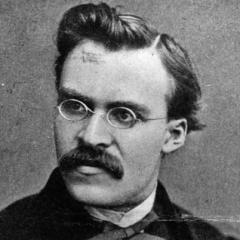
Friedrich Nietzsche was a German philosopher, cultural critic, poet, and writer whose works have had a profound impact on subsequent philosophy, literature, and thought. His ideas revolve around concepts such as the 'will to power', the 'Übermensch', and the 'eternal recurrence'. more

You May Also Like

“...when do I actually encounter the Other 'beyond the wall of language', in the rel of his or her being? Not when I am able to describe her, not even when I learn her values, dreams, and so on, but only when I encounter the Other in her moment of jouissance: when I discern in her a tiny detail (a compulsive gesture, a facial expression, a tic) which signals the intensity of the real of jouissance. This encounter with the real is always traumatic; there is something at least minimally obscene about it; I cannot simply integrate it into my universe, there is always a gulf separating me from it.”

“In order to grasp how exploitation is overcome by sublimation, it is not enough to stay with this standard definition of sublimation as the elevation of an ordinary object to the dignity of a Thing. As Lacan aptly demonstrated apropos courtly love, an ordinary object (woman) is there elevated to the dignity of the Thing, she becomes an “inhuman partner,” dangerous to get too close to, always out of reach, mixing horror and respect. The paradox of desire is here brought to an extreme, turning the experience of love into an endlessly postponed tragedy. In true love, however, comedy enters: while the beloved remains a Thing, it is simultaneously “desublimated,” accepted in all her ridiculous bodily imperfections. A true miracle is thus achieved: I can hold the Thing-jouissance in my hands, making fun of it and playing games with it, enjoying it without restraint – true love doesn’t idealize – or, as Lacan put it in his seminar on anxiety: “Only love-sublimation makes it possible for jouissance to condescend to desire.” This enigmatic proposition was perspicuously interpreted by Alenka Zupančič who demonstrated how, in the comedy of love, sublimation paradoxically comprises its opposite, desublimation – you remain the Thing, but simultaneously I can use you for my enjoyment: “to love the other and to desire my own jouissance. To ‘desire one’s own jouissance’ is probably what is the hardest to obtain and to make work, since the enjoyment has trouble appearing as an object.” One should not shirk from a quite concrete and graphic description of what this amounts to: I love you, and I show this by fucking you just for pleasure, mercilessly objectivizing you – this is how I am no longer exploited by serving the Other’s enjoyment. When I worry all the time whether you also enjoy it, it is not love – “I love you” means: I want to be used as an object for your enjoyment. One should reject here all the Catholic nonsense of preferring the missionary position in sex because lovers can whisper tender words and communicate spiritually, and even Kant was too short here when he reduced the sexual act to reducing my partner to an instrument of my pleasure: self-objectivization is the proof of love, you find being used degrading only if there is no love. This enjoyment of mine should not be constrained even by the tendency to enable my partner to reach orgasm simultaneously with me – Brecht was right when, in his poem “Orges Wunschliste,” he includes in the wish-list of his preferences non-simultaneous orgasms: “Von den Mädchen, die neuen. / Von den Weibern, die ungetreuen. / Von den Orgasmen, die ungleichzeitigen. / Von den Feindschaften, die beiderseitigen.” “Of the girls, the new. / Of the women, the unfaithful. / Of orgasms, the non-simultaneous. / Of the animosities, the mutual.”

“Solitude does not necessarily mean living apart from others; rather, it means never living apart from one’s self. A Hidden Wholeness: The Journey Toward an Undivided Life”

“Well into his thirties he dreamed of having to go to school as a grown-up, opening his desk, and rummaging inside to hide his face, “suffering over again with increased intensity the shyness and sense of disgrace of my boyhood.” And yet Wallace came to be grateful for what he called his “constitutional shyness,” which he felt had given him long periods of solitary study and a hesitancy over words that led him to avoid the verbosity that marred so many scholarly works.”