Quotessence
Home / Quotes / Quote by Paul Tillich

Quote by Paul Tillich

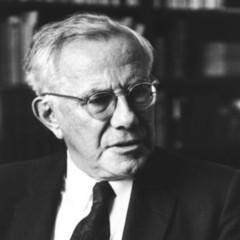
“Man is essentially 'finite freedom'; freedom not in the sense of indeterminacy but in the sense of being able to determine himself through decisions in the center of his being. Man, as finite freedom, is free within the contingencies of his finitude. But within these limits he is asked to make of himself what he is supposed to become, to fulfill his destiny.”

Quote by Paul Tillich

Work

The Courage To Be

This book delves into the complexities of individual identity and the challenges of living authentically. It examines the fear of being oneself and the courage required to overcome societal pressures and expectations. more

Author

Paul Tillich
Paul Tillich

Paul Tillich (August 20, 1886 - October 22, 1965) was a German-American philosopher and theologian known for his profound contributions to religious philosophy, particularly on the concept of religious existence. His ideas have had a significant impact on 20th-century religious philosophy, theology, and theological ethics. more

You May Also Like

“In order to make a lasting contribution to humanity, we cannot allow other people’s expectancies to limit our development or restrict our dreams. We must live our own lives unaffected by other people’s expectations.”

“Man is not fully conditioned and determined but rather determines himself whether he gives in to conditions or stands up to them. In other words, man is ultimately self-determining. Man does not simply exist but always decides what his existence will be, what he will become in the next moment. By the same token, every human being has the freedom to change at any instant. Therefore, we can predict his future only within the large framework of a statistical survey referring to a whole group; the individual personality, however, remains essentially unpredictable. The basis for any predictions would be represented by biological, psychological or sociological conditions. Yet one of the main features of human existence is the capacity to rise above such conditions, to grow beyond them.”

“Socialism' should not be taken to mean merely subordinating the economy to the needs and values of society. It also involves the creation, as an effect of ever shorter and increasingly flexible working hours, of a growing sphere of sharing within the community, of voluntary and self-organized co-operation, of increasingly extensive self-determined activities.”

“Self-image is the product of our very own spin machine. Revolutions of long-term memories and the gyrations of short-term thoughts fabricate the epicycle of our present self-image. Once a synchronized self-image is developed, the human mind exhibits a tenacious tendency to maintain that centralized self-image through selective recall of prior events and by displaying a corresponding perception bias in interpreting present day experiences. In short, once we come to a firm belief of what we are, we exercise various mental and emotional prejudices to confirm and sustain our self-image.”

“Dangerous falsehoods prevent a person from maturing into his or her essential self. Recognizing personal fictions is the first step in self-healing and personal transcendence. Americans tend to focus on obtaining exterior symbols of success rather than working to awaken their consciousness. Valuing people by their usefulness and richness discounts the innate dignity of humankind. The quality of a person’s consciousness determines his or her capability to experience bliss. Ego gratification represents the darkest part of human nature.”

“Select people find themselves early on in life, while other people undergo painful stages of vast changes. Some people never exhibit a centralizing persona and they tend to undergo a series of crisis throughout their lives. I observed some friends, family members, and other acquaintances at various stages in their lives and they seem virtually the same person years later. I am a person who cyclically turns himself inside out after crashing and burning, failing, and then reassembling the seeds of defeat into new victories, only to run aground again. I mentally and emotionally resist change and must consciously force a personal metamorphosis. Could I radically change again? Did I possess the internal reserves to weather a period of reconstitution and then make myself over into a new prototype? Can I will myself to becoming the person I aspire to be? Can I take advantage of human consciousness to broker a way out of self-defeat and a misery-ridden life?”

“Free will and the choices that we make every day provides for self-identification. We all hold the plenary powers of discretion to script who and what we are. Self-determination comes from refusal to passively accept whatever doctrine is convenient and move beyond glib answers and popular canons to staunch the torrent of life’s abuses. Intensely pushing forward into troubled waters the clear becomes murky, the certain become problematic, and the real become ethereal. Striping our consciousness of all familiar handholds can lead to dissolution of the sense of a transient self. Disintegration of a preconceived notion of self-identity can lead to either psychosis or a degree of self-mastery, depending upon an individual’s ability to absorb and integrate the secret reserves of their psyche power. Self-awareness comes at a high price but it has distinct rewards. Shrewdly shredded of all falsities we can see what is apparent. Brusquely scouring our brain of layers of toxic emotional sludge reveals a sterling center point. Starting anew we can launch ourselves in a more charming and cheerful image that is both natural and necessary to build upon in order to achieve and sustain our robust constitutional fortitude.”