Quotessence
Home / Quotes / Quote by Carl Sagan

Quote by Carl Sagan

Work

The Demon-Haunted World: Science as a Candle in the Dark

In this seminal work, the author delves into the principles of scientific inquiry, critical analysis, and evidence-based reasoning. The book serves as a guide to discerning fact from fiction, advocating for the importance of skepticism and rationality in understanding the natural world. more

Author
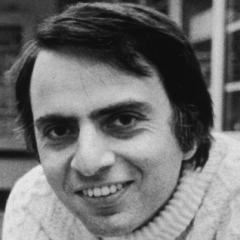
Carl Sagan
Carl Sagan

Carl Sagan was an American astronomer, cosmologist, author, and science communicator, born on November 9, 1934, in Brooklyn, New York. He is renowned for his profound research into the cosmos and his dedication to popularizing science. Sagan proposed numerous theories about the origin of the universe and life, and he made complex scientific knowledge accessible to the public with his unique perspective and clear, engaging writing style. more

You May Also Like

“I believed that the woods were not tenantless, but choke-full of honest spirits as good as myself any day– not an empty chamber in which chemistry was left to work alone, but an inhabited house. It suggested, too, that the same experience always gives birth to the same sort of belief or religion. One revelation has been made to the Indian, another to the white man. I have much to learn of the Indian, nothing of the missionary. I am not sure but all that would tempt me to teach the Indian my religion would be his promise to teach me his. Long enough I had heard of irrelevant things; now at length I was glad to make acquaintance with the light that dwells in rotten wood.”

“It may be indispensable that Our Lord's teaching, by that elusiveness (to our systematising intellect), should demand a response from the whole man, should make it so clear that there is no question of learning a subject but of steeping ourselves in a Personality, acquiring a new outlook and temper, breathing a new atmosphere, suffering Him, in His own way, to rebuild in us the defaced image of Himself.”

“We may observe that the teaching of Our Lord Himself, in which there is no imperfection, is not given us in that cut-and-dried, fool-proof, systematic fashion we might have expected or desired. He wrote no book. We have only reported sayings, most of them uttered in answer to questions, shaped in some degree by their context. And when we have collected them all we cannot reduce them to a system. He preaches but He does not lecture. He uses paradox, proverb, exaggeration, parable, irony; even (I mean no irreverence) the 'wisecrack'. He utters maxims which, like popular proverbs, if rigorously taken, may seem to contradict one another. His teaching therefore cannot be grasped by the intellect alone, cannot be 'got up' as if it were a 'subject'. If we try to do that with it, we shall find Him the most elusive of teachers. He hardly ever gave a straight answer to a straight question. He will not be, in the way we want, 'pinned down'. The attempt is (again, I mean no irreverence) like trying to bottle a sunbeam.”

“Era stanco di non combinare nulla, di tirare il diavolo per la coda, di espedienti e di intrighi. A novembre avrebbe compiuto trentun anni. Non avrebbe mai avuto un lavoro decoroso? Non avrebbe mai avuto una casa sua? Pensò a quanto sarebbe stato bello avere un fuoco acceso presso cui sedersi e una buona cena davanti. Aveva bighellonato troppo tempo con gli amici e con le ragazze. Sapeva quanto valevano questi amici e anche le ragazze.”