Quotessence
Home / Quotes / Quote by Pope Benedict XVI

Quote by Pope Benedict XVI

“How many winds of doctrine we have known in recent decades, how many ideological currents, how many ways of thinking. The small boat of thought of many Christians has often been tossed about by these waves - thrown from one extreme to the other: from Marxism to liberalism, even to libertinism; from collectivism to radical individualism; from atheism to a vague religious mysticism; from agnosticism to syncretism, and so forth. Every day new sects are created and what Saint Paul says about human trickery comes true, with cunning which tries to draw those into error (cf Ephesians 4, 14). Having a clear Faith, based on the Creed of the Church, is often labeled today as a fundamentalism. Whereas, relativism, which is letting oneself be tossed and 'swept along by every wind of teaching', looks like the only attitude acceptable to today's standards. We are moving towards a dictatorship of relativism which does not recognize anything as certain and which has as its highest goal one's own ego and one's own desires. However, we have a different goal: the Son of God, true man. He is the measure of true humanism. Being an 'Adult' means having a faith which does not follow the waves of today's fashions or the latest novelties. A faith which is deeply rooted in friendship with Christ is adult and mature. It is this friendship which opens us up to all that is good and gives us the knowledge to judge true from false, and deceit from truth.”

Quote by Pope Benedict XVI

Author
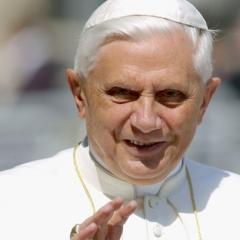
Pope Benedict XVI
Pope Benedict XVI

Pope Benedict XVI, born Joseph Aloisius Ratzinger, was the 265th Pope of the Roman Catholic Church, serving from 2005 to 2013. He had a deep academic background in philosophy and theology, serving as a Cardinal and President of the Pontifical Biblical Commission. During his papacy, Pope Benedict XVI worked to promote church reform and dialogue, emphasizing the importance of traditional doctrine while balancing conservative and reformist forces within the church. more

You May Also Like

“The beauty in correcting our own mistakes; rather than attempting to correct the mistakes in others, is that working upon our own flaws improves us. But working upon the flaws of others not only leaves us unimproved; it actually leaves us being less than we were prior to making those assessments. I believe that the moral of this natural occurrence, is that we are all born to find and fix our own shortcomings; rather than find and fix the shortcomings in others. And if all people were to do this, then we would be a race of creatures looking inward, in order to bring out something better. Now think of what a beautiful race that would be.”

“The humanitarian philosophies that have been developed (sometimes under some religious banner and invariably in the face of religious opposition) are human inventions, as the name implies - and our species deserves the credit. I am a devout atheist - nothing else makes any sense to me and I must admit to being bewildered by those, who in the face of what appears so obvious, still believe in a mystical creator. However I can see that the promise of infinite immortality is a more palatable proposition than the absolute certainty of finite mortality which those of us who are subject to free thought (as opposed to free will) have to look forward to and many may not have the strength of character to accept it. Thus I am a supporter of Amnesty International, a humanist and an atheist. I believe in a secular, democratic society in which women and men have total equality, and individuals can pursue their lives as they wish, free of constraints - religious or otherwise. I feel that the difficult ethical and social problems which invariably arise must be solved, as best they can, by discussion and am opposed to the crude simplistic application of dogmatic rules invented in past millennia and ascribed to a plethora of mystical creators - or the latest invention; a single creator masquerading under a plethora of pseudonyms. Organisations which seek political influence by co-ordinated effort disturb me and thus I believe religious and related pressure groups which operate in this way are acting antidemocratically and should play no part in politics. I also have problems with those who preach racist and related ideologies which seem almost indistinguishable from nationalism, patriotism and religious conviction.”

“The predisposition to religious belief is an ineradicable part of human behavior. Mankind has produced 100,000 religions. It is an illusion to think that scientific humanism and learning will dispel religious belief. Men would rather believe than know... A kind of Darwinistic survival of the fittest has occurred with religions... The ecological principle called Gause's law holds that competition is maximal between species with identical needs... Even submission to secular religions such as Communism and guru cults involve willing subordination of the individual to the group. Religious practices confer biological advantage. The mechanisms of religion include (1) objectification (the reduction of reality to images and definitions that are easily understood and cannot be refuted), (2) commitment through faith (a kind of tribalism enacted through self-surrender), (3) and myth (the narratives that explain the tribe's favored position on the earth, often incorporating supernatural forces struggling for control, apocalypse, and millennium).”

“It is no longer just engineers who dominate our technology leadership, because it is no longer the case that computers are so mysterious that only engineers can understand what they are capable of. There is an industry-wide shift toward more "product thinking" in leadership--leaders who understand the social and cultural contexts in which our technologies are deployed. Products must appeal to human beings, and a rigorously cultivated humanistic sensibility is a valued asset for this challenge. That is perhaps why a technology leader of the highest status--Steve Jobs--recently credited an appreciation for the liberal arts as key to his company's tremendous success with their various i-gadgets.”

“But it will be asked: What is the force and power of the blessings and curses of men, even if these men be such giants as Plato and Aristotle? Does truth become more true because Aristotle blesses it, or does it become error because Plato curses it? Is it given men to judge the truths, to decide the fate of the truths? On the contrary, it is the truths which judge men and decide their fate and not men who rule over the truths. Men, the great as well as the small, are born and die, appear and disappear - but the truth remains. When no one had as yet begun to "think" or to "search," the truths which later revealed themselves to men already existed. And when men will have finally disappeared from the face of the earth, or will have lost the faculty of thinking, the truths will not suffer therefrom.”

“Living the good life as created beings depends on living within the limits and according to the truths of the human condition. Purity of heart and the capacity to channel desires toward personal self-mastery in holiness are part of the high calling of the Christian life. These remain necessities, despite the promises of a false humanism that claims that human nature has neither limits nor boundaries, being infinitely plastic and malleable -- a vain and counterproductive attempt to liberate humans from guilt.”