Quotessence
Home / Quotes / Quote by Daphne du Maurier

Quote by Daphne du Maurier

“I wondered straightaway how he could sit at peace there, of an evening, with the row of heads staring down at him. There were no pictures, no flowers: only the heads of chamois. The concession to melody was the radiogram and the stack of records of classical music. Foolishly, I had asked, "Why only chamois?" He answered at once, "They fear Man." This might have led to an argument about animals in general, domestic, wild, and those which adapt themselves to the whims and vagaries of the human race; but instead he changed the subject abruptly, put on a Sibelius record, and presently made love to me, intently but without emotion. I was surprised but pleased. I thought, "We are suited to one another. There will be no demands. Each of us will be self-contained and not beholden to the other." All this came true, but something was amiss. There was a flaw - not only the nonappearance of children, but a division of the spirit. The communion of flesh which brought us together was in reality a chasm, and I despised the bridge we made. Perhaps he did as well. I had been endeavouring for ten years to build for my self a ledge of safety. ("The Chamois")”

Quote by Daphne du Maurier

Work

Echoes from the Macabre: Selected Stories

Browse quotes and source details for this work. more

Author
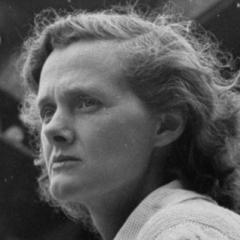
Daphne du Maurier
Daphne du Maurier

British author known for her suspense novels and romantic stories. Daphne du Maurier's works are characterized by their mysterious and supernatural elements, with her most famous novels being 'Rebecca' and 'The Turn of the Screw'. Her writing style has had a profound impact on literature. more

You May Also Like

“I pray that the world never runs out of dragons. I say that in all sincerity, though I have played a part in the death of one great wyrm. For the dragon is the quintessential enemy, the greatest foe, the unconquerable epitome of devastation. The dragon, above all other creatures, even the demons and the devils, evokes images of dark grandeur, of the greatest beast curled asleep on the greatest treasure hoard. They are the ultimate test of the hero and the ultimate fright of the child. They are older than the elves and more akin to the earth than the dwarves. The great dragons are the preternatural beast, the basic element of the beast, that darkest part of our imagination. The wizards cannot tell you of their origin, though they believe that a great wizard, a god of wizards, must have played some role in the first spawning of the beast. The elves, with their long fables explaining the creation of every aspect of the world, have many ancient tales concerning the origin of the dragons, but they admit, privately, that they really have no idea of how the dragons came to be. My own belief is more simple, and yet, more complicated by far. I believe that dragons appeared in the world immediately after the spawning of the first reasoning race. I do not credit any god of wizards with their creation, but rather, the most basic imagination wrought of unseen fears, of those first reasoning mortals. We make the dragons as we make the gods, because we need them, because, somewhere deep in our hearts, we recognize that a world without them is a world not worth living in. There are so many people in the land who want an answer, a definitive answer, for everything in life, and even for everything after life. They study and they test, and because those few find the answers for some simple questions, they assume that there are answers to be had for every question. What was the world like before there were people? Was there nothing but darkness before the sun and the stars? Was there anything at all? What were we, each of us, before we were born? And what, most importantly of all, shall we be after we die? Out of compassion, I hope that those questioners never find that which they seek. One self-proclaimed prophet came through Ten-Towns denying the possibility of an afterlife, claiming that those people who had died and were raised by priests, had, in fact, never died, and that their claims of experiences beyond the grave were an elaborate trick played on them by their own hearts, a ruse to ease the path to nothingness. For that is all there was, he said, an emptiness, a nothingness. Never in my life have I ever heard one begging so desperately for someone to prove him wrong. This is kind of what I believe right now… although, I do not want to be proved wrong… For what are we left with if there remains no mystery? What hope might we find if we know all of the answers? What is it within us, then, that so desperately wants to deny magic and to unravel mystery? Fear, I presume, based on the many uncertainties of life and the greatest uncertainty of death. Put those fears aside, I say, and live free of them, for if we just step back and watch the truth of the world, we will find that there is indeed magic all about us, unexplainable by numbers and formulas. What is the passion evoked by the stirring speech of the commander before the desperate battle, if not magic? What is the peace that an infant might know in its mother’s arms, if not magic? What is love, if not magic? No, I would not want to live in a world without dragons, as I would not want to live in a world without magic, for that is a world without mystery, and that is a world without faith. And that, I fear, for any reasoning, conscious being, would be the cruelest trick of all. -Drizzt Do’Urden”

“The mass of the population before the modern era rarely ate meat as the mass of the peasantry rarely do in underdeveloped countries today. In Europe, in the Middle Ages, meat, especially red meat, was associated with aristocracy, landed gentry and their militaristic and hunting culture. It was this, also, that tended to strengthen the association of meat with power and aggression.”

“The change which would be produced by simpler habits on political economy is sufficiently remarkable. The monopolising eater of animal flesh would no longer destroy his constitution by devouring an acre at a meal … The quantity of nutritious vegetable matter consumed in fattening the carcase of an ox, would afford ten times the sustenance, undepraving indeed, and incapable of generating disease, if gathered immediately from the bosom of the earth.”

“The most fertile districts of the habitable globe are now actually cultivated by men for animals, at a delay and waste of aliment absolutely incapable of calculation. It is only the wealthy that can, to any great degree, even now, indulge the unnatural craving for dead flesh, and they pay for the greater licence of privilege, by subjection to supernumerary diseases.”

“Several previous researches reported that stroke incidence is greater among participants with a higher consumption of red and processed meats because they tend to have unhealthy behaviors and conditions.15, 24, 25 Although studies included in this meta‐analysis adjusted for major stroke risk factors such as hypertension, diabetes mellitus, smoking, obesity, and alcohol use, the effect of unadjusted risk factors still remain.”