Quotessence
Home / Quotes / Quote by Anthony Burgess

Quote by Anthony Burgess

Work

Earthly Powers

This book is a complex narrative that delves into the lives of various characters as they navigate the intricate web of power dynamics and political intrigue during the 20th century. The story is rich with historical context and offers a nuanced look at the human condition. more
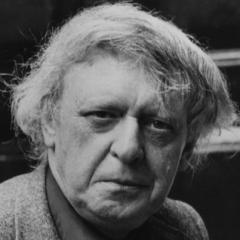
Author

Anthony Burgess
Anthony Burgess

Anthony Burgess, born on February 25, 1917, in Manchester, England, was an accomplished British writer known for his distinctive literary style and profound insights into human psychology. His works spanned various literary genres, including novels, plays, and poetry. Burgess' most famous novel, A Clockwork Orange, is one of the most celebrated works of the 20th century, exploring themes such as free will, morality, and social control. more

You May Also Like

“Common man does not speculate about the great problems. With regard to them he relies upon other people's authority, he behaves as "every decent fellow must behave,'' he is like a sheep in the herd. It is precisely this intellectual inertia that characterizes a man as a common man. Yet the common man does choose. He chooses to adopt traditional patterns or patterns adopted by other people because he is convinced that this procedure is best fitted to achieve his own welfare. And he is ready to change his ideology and consequently his mode of action whenever he becomes convinced that this would better serve his own interests.”

“I was on one of my world 'walkabouts.' It had taken me once more through Hong Kong, to Japan, Australia, and then Papua New Guinea in the South Pacific [one of the places I grew up]. There I found the picture of 'the Father.' It was a real, gigantic Saltwater Crocodile (whose picture is now featured on page 1 of TEETH). From that moment, 'the Father' began to swim through the murky recesses of my mind. Imagine! I thought, men confronting the world’s largest reptile on its own turf! And what if they were stripped of their firearms, so they must face this force of nature with nothing but hand weapons and wits? We know that neither whales nor sharks hunt individual humans for weeks on end. But, Dear Reader, crocodiles do! They are intelligent predators that choose their victims and plot their attacks. So, lost on its river, how would our heroes escape a great hunter of the Father’s magnitude? And what if these modern men must also confront the headhunters and cannibals who truly roam New Guinea? What of tribal wars, the coming of Christianity and materialism (the phenomenon known as the 'Cargo Cult'), and the people’s introduction to 'civilization' in the form of world war? What of first contact between pristine tribal culture and the outside world? What about tribal clashes on a global scale—the hatred and enmity between America and Japan, from Pearl Harbor, to the only use in history of atomic weapons? And if the world could find peace at last, how about Johnny and Katsu?”