Quotessence
Home / Quotes / Quote by Jorge Luis Borges

Quote by Jorge Luis Borges

“I owe my first inkling of the problem of infinity to a large biscuit tin that was a source of vertiginous mystery during my childhood.”

Quote by Jorge Luis Borges

Author
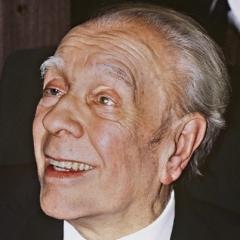
Jorge Luis Borges
Jorge Luis Borges

Jorge Luis Borges was an Argentine writer, poet, and literary critic. His works are known for their unique fantasy and philosophical thinking, which have had a profound impact on 20th-century literature. more

You May Also Like

“It was that evening, when my mother abdicated her authority, that marked the beginning, along with the slow death of my grandmother, of the decline of my will and of my health. Everything had been decided at the moment when, unable to bear the idea of waiting until the next day to set my lips on my mother's face, I had made my resolution, jumped out of bed, and gone, in my nightshirt, to stay by the window through which the moonlight came, until I heard M. Swann go. My parents having gone with him, I heard the garden gate open, the bell ring, the gate close again...”

“There must be some other possibility than death or lifelong penance ... some meeting, some intersection of lines; and some cowardly, hopeful geometer in my brain tells me it is the angle at which two lines prop each other up, the leaning-together from the vertical which produces the false arch. For lack of a keystone, the false arch may be as much as one can expect in this life. Only the very lucky discover the keystone.”

“Yo había crecido en el convencimiento de que aquella lenta procesión de la posguerra, un mundo de quietud, miseria y rencores velados, era tan natural como el agua del grifo, y que aquella tristeza muda que sangraba por las paredes de la ciudad herida era el verdadero rostro de su alma. Una de las trampas de la infancia es que no hace falta comprender algo para sentirlo. Para cuando la razón es capaz de entender lo sucedido, las heridas en el corazón ya son demasiado profundas. Aquella noche primeriza de verano, caminando por ese anochecer oscuro y traicionero de Barcelona, no conseguía borrar de mi pensamiento el relato de Clara en torno a la desaparición de su padre. En mimundo, la muerte era una mano anónima e incomprensible, un vendedor a domicilio que se llevaba madres, mendigos o vecinos nonagenarios como si se tratase de una lotería del infierno. La idea de que la muerte pudiera caminar a mi lado, con rostro humano y corazón envenenado de odio, luciendo uniforme o gabardina, que hiciese cola en el cine, riese en los bares o llevase a los niños de paseo al parque de la Ciudadela por la mañana y por la tarde hiciese desaparecer a alguien en las mazmorras del castillo de Montjuïc, o en una fosa común sin nombre ni ceremonial, no me cabía en la cabeza. Dándole vueltas, se me ocurrió que tal vez aquel universo de cartón piedra que yo daba porbueno no fuese más que un decorado. En aquellos años robados, el fin de la infancia, como la Renfe, llegaba cuando llegaba.”

“Now this is a most satisfactory and important thing to think about, for brutality will not,—cannot,—accomplish what a kindly disposition will; and, if folks could only know how quickly a “balky” child will, through loving and cuddling, grow into a charming, happy youth, much childish gloom and sorrow would vanish; for a man or woman who is ugly to a child is too low to rank as highly as a wild animal; for no animal will stand, for an instant, anything approaching an attack, or any form of harm to its young. But what a lot of tots find slaps, yanks and hard words for conditions which do not call for such harsh tactics! No child is naturally ugly or “cranky.” And big, gulping sobs, or sad, unhappy young minds, in a tiny body should not occur in any community of civilization. Adulthood holds many an opportunity for such conditions. Childhood should not.”

“Youth!! Ah, what a word!! And how transitory! But, how grand! as long as it lasts. How many millions in gold would pour out for an ability to call it all back, as with our musical myth, Faust. During that magic part of a child’s growth this world is just a gigantic inquiry box, containing many a topic for which a solution is paramount to a growing mind. And to whom can a child look, but us adults? Any man who “can’t stop now” to talk with a child upon a topic which, to him is“too silly for anything,” should look back to that day upon which that topic was dark and dubious in his own brain. A child who asks nothing will know nothing. That is why that “bump of inquiry” was put on top of our skulls.”