Quotessence
Home / Quotes / Quote by Samuel Johnson

Quote by Samuel Johnson

Author

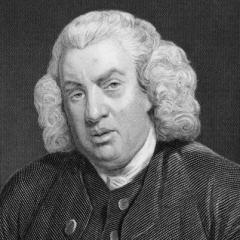
Samuel Johnson
Samuel Johnson

Samuel Johnson was an English writer, poet, and lexicographer, renowned for his comprehensive English dictionary, 'A Dictionary of the English Language', published in 1755. His distinctive writing style and wit have cemented his place as a significant figure in the history of English literature. more

You May Also Like

“The vainglory of wishing to understand is dangerous, immoral and, above all, old-fashioned. The modern way – perhaps the final way - is to say: Go forward, without knowing why, as quickly as possible, towards an unknown goal! To act and think are opposites which identify one only in the Absolute. To accomplish all one's movements – of the head, the arms, the legs – without ever quite attaining the status of a puppet, but with a certainty that gives one a feeling of rightness: that is what is nowadays held up as the ideal. Be citizens of Universal activity! Forget to be conscious of ourselves! The blind horse gallops without hesitation, not knowing where it is going, not caring where it has been: so let up put out our eyes!”

“I find it most offensive that the character of Reason, whom [Jean den Meun (author of the Romance of the Rose)] himself calls the daughter of God, should put forth such a statement as ... where she says by way of a proverb that "in the war of Love it is better to deceive than be deceived." And indeed I dare say that in making that statement Jean den Meun's Reason denied her Father, for the doctrine He gave was altogether different.”

“The fantastic in literature doesn't exist as a challenge to what is probable, but only there where it can be increased to a challenge of reason itself: the fantastic in literature consists, when all has been said, essentially in showing the world as opaque, as inaccessible to reason on principle. This happens when Piranesi in his imagined prisons depicts a world peopled by other beings than those for which it was created. ("On the Fantastic in Literature")”

“We say 'everyone is entitled to his beliefs', recognising the nastiness of a world which will not tolerate alternative beliefs, but over-looking the fact that some beliefs are nonsense and deserve to be called prejudice, bigotry or superstition rather than merely belief. But as Pascal knew, our prejudices do not respond to reason alone. It is as though all the proofs and evidence of philosophy had mistaken their rationality for how people actually think.”