Quotessence
Home / Authors / Socrates
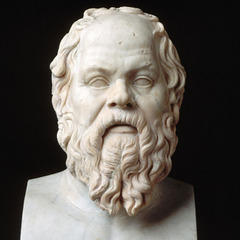
Socrates

Socrates Quotes

Philosopher

Filter quotes by topic

Famous Socrates Quotes

“Suppose... that you acquit me... Suppose that, in view of this, you said to me 'Socrates, on this occasion we shall disregard Anytus and acquit you, but only on one condition, that you give up spending your time on this quest and stop philosophizing. If we catch you going on in the same way, you shall be put to death.' Well, supposing, as I said, that you should offer to acquit me on these terms, I should reply 'Gentlemen, I am your very grateful and devoted servant, but I owe a greater obedience to God than to you; and so long as I draw breath and have my faculties, I shall never stop practicing philosophy and exhorting you and elucidating the truth for everyone that I meet. I shall go on saying, in my usual way, "My very good friend, you are an Athenian and belong to a city which is the greatest and most famous in the world for its wisdom and strength. Are you not ashamed that you give your attention to acquiring as much money as possible, and similarly with reputation and honour, and give no attention or thought to truth and understanding and the perfection of your soul?" And if any of you disputes this and professes to care about these things, I shall not at once let him go or leave him; no, I shall question him and examine him and test him; and if it appears that in spite of his profession he has made no real progress towards goodness, I shall reprove him for neglecting what is of supreme importance, and giving his attention to trivialities. I shall do this to everyone that I meet, young or old, foreigner or fellow-citizen; but especially to you my fellow-citizens, inasmuch as you are closer to me in kinship. This, I do assure you, is what my God commands; and it is my belief that no greater good has ever befallen you in this city than my service to my God; for I spend all my time going about trying to persuade you, young and old, to make your first and chief concern not for your bodies nor for your possessions, but for the highest welfare of your souls, proclaiming as I go 'Wealth does not bring goodness, but goodness brings wealth and every other blessing, both to the individual and to the State.' ...And so, gentlemen, I would say, 'You can please yourselves whether you listen to Anytus or not, and whether you acquit me or not; you know that I am not going to alter my conduct, not even if I have to die a hundred deaths.”

“...[Y]ou know very well the truth of what I [say]... I have incurred a great deal of bitter hostility; and this is what will bring about my destruction, if anything does... the slander and jealousy of a very large section of the people. They have been fatal to a great many other innocent men, and I suppose will continue to be so; there is no likelihood that they will stop at me. But perhaps someone will say 'Do you feel no compunction, Socrates, at having followed a line of action which puts you in danger of the death-penalty?' I might fairly reply to him 'You are mistaken, my friend, if you think that a man who is worth anything ought to spend his time weighing up the prospects of life and death. He has only one thing to consider in performing any action; that is, whether he is acting rightly or wrongly, like a good man or a bad one...['] The truth of the matter is this, gentlemen. Where a man has once taken up his stand, either because it seems best to him or in obedience to his orders, there I believe he is bound to remain and face the danger, taking no account of death or anything else before dishonour.”

“There is one way, then, in which a man can be free from all anxiety about the fate of his soul - if in life he has abandoned bodily pleasures and adornments, as foreign to his purpose and likely to do more harm than good, and has devoted himself to the pleasures of acquiring knowledge, and so by decking his soul not with a borrowed beauty but with its own - with self-control, and goodness, and courage, and liberality, and truth - has fitted himself to await his journey in the next world.”

“...I do not believe that the law of God permits a better man to be harmed by a worse. No doubt my accuser might put me to death or have me banished or deprived of civic rights; but even if he thinks, as he probably does (and others to, I dare say), that these are great calamities, I do not think so... For let me tell you, gentlemen, that to be afraid of death is only another form of thinking that one is wise when one is not; it is to think that one knows what one does not know. No one knows with regard to death whether it is not really the greatest blessing that can happen to a man; but people dread it as though they were certain that it is the greatest evil; and this ignorance, which thinks that it knows what it does not, must surely be ignorance most culpable. This, I take it, gentlemen, is the degree, and this is the nature of my advantage over the rest of mankind; and if I were to claim to be wiser than my neighbour in any respect, it would be in this: that not possessing any real knowledge of what comes after death, I am also conscious that I do not possess it. But I do know that to do wrong and to disobey my superior, whether God or man, is wicked and dishonourable; and so I shall never feel more fear or aversion for something which, for all I know, may really be a blessing, than for those evils which I know to be evils.”

“Let us reflect in another way, and we shall see that there is great reason to hope that death is a good; for one of two things—either death is a state of nothingness and utter unconsciousness, or, as men say, there is a change and migration of the soul from this world to another. Now if you suppose that there is no consciousness, but a sleep like the sleep of him who is undisturbed even by dreams, death will be an unspeakable gain. For if a person were to select the night in which his sleep was undisturbed even by dreams, and were to compare with this the other days and nights of his life, and then were to tell us how many days and nights he had passed in the course of his life better and more pleasantly than this one, I think that any man, I will not say a private man, but even the great king will not find many such days or nights, when compared with the others. Now if death be of such a nature, I say that to die is gain; for eternity is then only a single night. But if death is the journey to another place, and there, as men say, all the dead abide, what good, O my friends and judges, can be greater than this? If indeed when the pilgrim arrives in the world below, he is delivered from the professors of justice in this world, and finds the true judges who are said to give judgment there, Minos and Rhadamanthus and Aeacus and Triptolemus, and other sons of God who were righteous in their own life, that pilgrimage will be worth making. What would not a man give if he might converse with Orpheus and Musaeus and Hesiod and Homer? Nay, if this be true, let me die again and again.”

“If the soul is immortal, it demands our care not only for that part of time which we call life, but for all time; and indeed it would seem now that it will be extremely dangerous to neglect it. If death were a release from everything, it would be a boon for the wicked, because by dying they would be released not only from the body but also from their own wickedness together with the soul; but as it is, since the soul is clearly immortal, it can have no escape of security from evil except by becoming as good and wise as it possibly can. For it takes nothing with it to the next world except its education and training...”

“I examined the poets, and I look on them as people whose talent overawes both themselves and others, people who present themselves as wise men and are taken as such, when they are nothing of the sort. From poets, I moved to artists. No one was more ignorant about the arts than I; no one was more convinced that artists possessed really beautiful secrets. However, I noticed that their condition was no better than that of the poets and that both of them have the same misconceptions. Because the most skillful among them excel in their specialty, they look upon themselves as the wisest of men. In my eyes, this presumption completely tarnished their knowledge. As a result, putting myself in the place of the oracle and asking myself what I would prefer to be — what I was or what they were, to know what they have learned or to know that I know nothing — I replied to myself and to the god: I wish to remain who I am. We do not know — neither the sophists, nor the orators, nor the artists, nor I— what the True, the Good, and the Beautiful are. But there is this difference between us: although these people know nothing, they all believe they know something; whereas, I, if I know nothing, at least have no doubts about it. As a result, all this superiority in wisdom which the oracle has attributed to me reduces itself to the single point that I am strongly convinced that I am ignorant of what I do not know.”

“...[I]f at the time of its release the soul is tainted and impure, because it has always associated with the body and cared for it and loved it, and has been so beguiled by the body and its passions and pleasures that nothing seems real to it but those physical things which can be touched and seen and eaten and drunk and used for sexual enjoyment; and if it is accustomed to hate and fear and avoid what is invisible and hidden from our eyes, but intelligible and comprehensible by philosophy - if the soul is in this state, do you think that it will escape independent and uncontaminated?”

“...I do not think that it is right for a man to appeal to the jury or to get himself acquitted by doing so; he ought to inform them of the facts and convince them by argument. The jury does not sit to dispense justice as a favour, but to decide where justice lies; and the oath which they have sworn is not to show favour at their own discretion, but to return a just and lawful verdict... Therefore you must not expect me, gentlemen, to behave towards you in a way which I consider neither reputable nor moral nor consistent with my religious duty.”

“Do you feel no compunction, Socrates, at having followed a line of action which puts you in danger of the death penalty?' I might fairly reply to him, 'You are mistaken, my friend, if you think that a man who is worth anything ought to spend his time weighing up the prospects of life and death. He has only one thing to consider in performing any action--that is, whether he is acting rightly or wrongly, like a good man or a bad one.”