Quotessence
Home / Quotes / Quote by Joseph Conrad

Quote by Joseph Conrad

“The great wall of vegetation, an exuberant and entangled mass of trunks, branches, leaves, boughs, festoons, motionless in the moonlight, was like a rioting invasion of soundless life, a rolling wave of plants, piled up, crested, ready to topple over the creek, to sweep every little man of us out of his little existence. And it moved not. A deadened burst of mighty splashes and snorts reached us from afar, as though an ichthyosaurus had been taking a bath of glitter in the great river.”

Quote by Joseph Conrad

Work

Heart of Darkness

Joseph Conrad's 'Heart of Darkness' is a seminal work that delves into the dark underbelly of colonialism and the psychological impact of exploration. The narrative follows Marlow, a seaman, as he navigates the treacherous Congo River and encounters the enigmatic Mr. Kurtz. more

Author

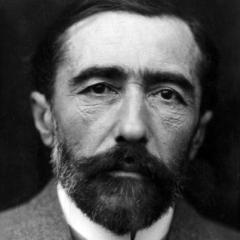
Joseph Conrad
Joseph Conrad

Joseph Conrad, born on December 3, 1857 in Poland and died on August 3, 1924 in the United Kingdom, was a renowned British author of the late 19th and early 20th centuries. He is known for his profound descriptions of maritime life and his insightful explorations of human nature. more

You May Also Like

“The writing style which is most natural for you is bound to echo the speech you heard when a child. English was the novelist Joseph Conrad's third language, and much of that seems piquant in his use of English was no doubt colored by his first language, which was Polish. And lucky indeed is the writer who has grown up in Ireland, for the English spoken there is so amusing and musical. I myself grew up in Indianapolis, where common speech sounds like a band saw cutting galvanized tin, and employs a vocabulary as unornamental as a monkey wrench. In some of the more remote hollows of Appalachia, children still grow up hearing songs and locutions of Elizabethan times. Yes, and many Americans grow up hearing a language other than English, or an English dialect a majority of Americans cannot understand. All these varieties of speech are beautiful, just as the varieties of butterflies are beautiful. No matter what your first language, you should treasure it all your life. If it happens not to be standard English, and if it shows itself when you write standard English, the result is usually delightful, like a very pretty girl with one eye that is green and one that is blue. I myself find that I trust my own writing most, and others seem to trust it most, too, when I sound most like a person from Indianapolis, which is what I am. What alternatives do I have? The one most vehemently recommended by teachers has no doubt been pressed on you, as well: to write like cultivated Englishmen of a century or more ago.”

“It was a wonderful experience. She mistrusted his very slumbers--and she seemed to think I could tell her why! Thus a poor mortal seduced by the charm of an apparition might have tried to wring from another ghost the tremendous secret of the claim the other world holds over a disembodied soul astray amongst the passions of this earth. The very ground on which I stood seemed to melt under my feet. And it was so simple too; but if the spirits evoked by our fears and our unrest have ever to vouch for each other's constancy before the forlorn magicians that we are, then I--I alone of us dwellers in the flesh--have shuddered in the hopeless chill of such a task.”

“It was then that Brown took his revenge upon the world which, after twenty years of contemptuous and reckless bullying, refused him the tribute of a common robber’s success. It was an act of cold-blooded ferocity, and it consoled him on his deathbed like a memory of an indomitable defiance. . . . Thus Brown balanced his account with the evil fortune. Notice that even in this awful outbreak there is a superiority as of a man who carries right—the abstract thing—within the envelope of his common desires. It was not a vulgar and treacherous massacre; it was a lesson, a retribution—a demonstration of some obscure and awful attribute of our nature which, I am afraid, is not so very far under the surface as we like to think.”

“People are wrong when they tell you that Conrad was on the side of Africans because his story showed great compassion towards them. Africans are not really served by his compassion, whatever it means; they ask for one thing alone – to be seen for what they are: human beings. Conrad pulls back from granting them this favour in Heart of Darkness.”

“La mia idea era di lasciare che la squadra di incatenati scomparisse alla vista prima di salire la collina. Sapete che non sono tenero in modo particolare; ho dovuto colpire e parare colpi. Ho dovuto difendermi e talvolta attaccare - il modo migliore per difendersi - senza calcolarne il costo esatto, secondo le necessità del genere di vita in cui ero incappato. Ho visto il demone della violenza, il demone della cupidigia, e il demone della bramosia bruciante; ma, per gli dèi!, erano demoni forti, vigorosi, dagli occhi ardenti, che scuotevano e trascinavano uomini - uomini, dico. Ma mentre ero su quella collina, previdi che nel sole accecante di quella terra avrei conosciuto un demone floscio, pretenzioso, dagli occhi smorti, di una follia rapace e spietata. Quanto insidioso potesse essere, dovevo impararlo soltanto dopo parecchi mesi e a mille miglia di distanza.”