“The ability to free oneself from the common tradition, a sort of liberal enlightenment, seems likely to be the most suitable basis for such a business man’s success. And today that is generally precisely the case. Any relationship between religious beliefs and conduct is generally absent, and where any exists, at least in Germany, it tends to be of the negative sort. The people filled with the spirit of capitalism today tend to be indifferent, if not hostile, to the Church. The thought of the pious boredom of paradise has little attraction for their active natures; religion appears to them as a means of drawing people away from labor in this world. If you ask them what is the meaning of their restless activity, why they are never satisfied with what they have, thus appearing so senseless to any purely worldly view of life, they would perhaps give the answer, if they know any at all: “to provide for my children and grandchildren.” But more often and, since that motive is not peculiar to them, but was just as effective for the traditionalist, more correctly, simply: that business with its continuous work has become a necessary part of their lives. That is in fact the only possible motivation, but it at the same time expresses what is, seen from the viewpoint of personal happiness, so irrational about this sort of life, where a man exists for the sake of his business, instead of the reverse.”
Quote by Max Weber
Work
This work examines the cultural and religious origins of modern economic behavior, arguing that certain Protestant doctrines, especially the concept of a worldly calling and predestination, fostered a disciplined, rational approach to work and wealth accumulation. The author contends that this ethic, while originally religious in nature, eventually became secularized and contributed to the spirit of modern capitalism, characterized by systematic, profit-oriented enterprise. The book remains a foundational text in sociology and economic history, sparking ongoing debate about the role of ideas in shaping economic systems. more
Author
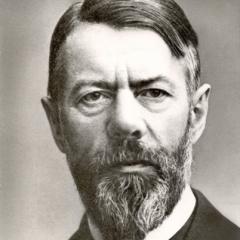
Max Weber was a German sociologist, political economist, and philosopher, a prominent figure in the social sciences in the late 19th and early 20th centuries. Known for his work on modern social structures, religious sociology, and political sociology, Weber's theories have had a profound impact on the fields of sociology, politics, and economics. more
You May Also Like
“Un metodo esiste solo se è scritto”
“You have never met someone who has worked too hard on the right thing.”
“Work that is truly Christian is work well done.”
“همه کاره بودن، اساسا نمی تواند کارآمدی بیاورد.”
“Everything seems better when we have to work to get it.”