Quotessence
Home / Quotes / Quote by Sophocles

Quote by Sophocles

“Oh my love take me there. Let me dwell where you are. I am already nothing, I am already burning. Oh my love, I was once part of you—take me too!”
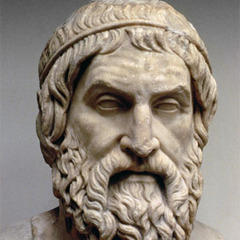
Quote by Sophocles

Book:Electra

Work

Electra

Browse quotes and source details for this work. more

Author

Sophocles
Sophocles

Sophocles, born in 498 BC and died in 406 BC, was a renowned Greek tragic playwright. He is one of the three greatest tragic poets of ancient Greece, alongside Aeschylus and Euripides. Sophocles' works profoundly revealed the complexity of human nature and social contradictions, exerting a profound influence on subsequent drama. more

You May Also Like

“She'd become accustomed to letting the garden grow uncontrolled since her father left. And that had suited both Harriet and the garden. They'd both been free to move about as they liked, to behave how it felt natural to behave. Harriet's decision not to prune was why the vines climbed so high along the house this summer, why the roses covered the garden walls and the blackberry brambles spread out as they did, decorating the bricks between the house and the railroad tracks with as many brilliant green leaves as menacing thorns. It was why the plum tree's fruit lay about the place all summer and its flowers bloomed brilliantly in the spring. It was why the bluebells stood in their own self-proliferating patches beneath the trees and rosebushes and wherever they pleased. Why her evergreen hedges were not neatly trimmed and why the hawthorn tree at the front towered over the gate. Her garden was filled with so much fierce beauty, she knew it would not take kindly to being clipped to the quick.”

“Purpose and Perspective: This work, which the author acknowledges is essentially a synthesis drawing upon the results of many other detailed studies, offers a new approach to both the burgeoning study of regions in English history and on the established discussion of the nature of Yorkist and early Tudor government (Foreword by Professor A. J. Pollard, p. iv). The study aims to explore whether a regional approach to late medieval English politics and governance is feasible, with specific reference to south-west England during the later fifteenth century. The relative importance of regions, in comparison to counties, will be explored by examination of the elites, politics, and government of Cornwall, Devon, Somerset, and Dorset from 1450 to 1500. But such an undertaking raises the fundamental question of whether a regional approach to the study of the south-western shires (or indeed any grouping of neighbouring counties anywhere in England) is valid–was there anything more to a ‘south-west region’ than simply a set of separate shires? That problem has made it necessary to study the south-west in a longer and broader context, in political terms, across the whole of the later fifteenth century (p.1). Certain aspects of the political history of south-west England have received attention from historians, mostly in the form of family or county studies… (p.19). Despite these admirable and informative studies, therefore, there are still significant lacunae in our understanding of particular aspects of the region’s governance during the later fifteenth century. Consequently, a regional investigation of the south-west political elites spanning the later fifteenth century might draw on earlier research and offer a broader perspective of court–country relations. A regional perspective of the interaction of local and national government would make possible a greater evaluation of the role of the duchy of Cornwall and the impact of the Wars of the Roses in the region (p. 21).”

“Edward IV’s ‘regional’ policy: The stimulus for this investigation was D.A.L. Morgan’s analysis of Edward IV’s second reign… Morgan proceeded to explain that this ‘territorial re-ordering’ was designed to cure disorder and lawlessness in the localities. Thus, Morgan suggested, Edward intended ‘the creation of an apanage’ for his second son, Richard, Duke of York, and that ‘by 1475 the plan was to endow him with a collection of lands in the East Midlands’. Also, the king ‘bent his efforts to making his elder son’s household at Ludlow the governing power in Wales and the West Midlands...and similarly to establishing his brother [Richard, Duke of] Gloucester as heir to the Neville lands and ruler of the North’. Furthermore ‘1474 saw the scheme pushed forward...and the beginning of an apanage endowment for the king’s stepson Thomas Grey [Marquess of Dorset] in the South-West’. Moreover, Edward’s ‘two leading household men were fitted in as the heads of further regional blocs’: his steward, Thomas, Lord Stanley, was ‘made undoubted ruler of Lancashire’, while ‘in Cheshire and north-east Wales also Stanley power was extended’ through Stanley’s brother, William; and the king’s chamberlain, William, Lord Hastings, ‘similarly emerged in 1474 as ruler of the North Midlands from Rockingham to the Peak’ (pp. 1–2). …the concept of Edward IV’s provincial policy raises much broader questions… whether this regional policy was planned or unintentional, and also as to whether its consequences were constructive or destructive. Furthermore, in a broader context, Edward’s scheme also suggests the importance of issues concerning the concept of regions, with potential implications for our study of politics and government in the localities, as well as questions regarding royal authority, governance, and the constitution, in general, in the later fifteenth century (p. 5). …This topic [Arbitration] is inseparable from the wider consideration of justice, and law and order, and these aspects could be the subject of substantial research in themselves; hence the remit of this study is specifically limited to questions of politics and governance. Arbitration of disputes may indicate a magnate’s influence and local standing, but this is, of course, not the only way in which to ascertain a magnate’s power in the localities: consideration of his estates, offices, and clientele reveals the extent to which his lordship pervaded local society (p. 8).”

“The difficulties of a (four-county) regional study: Since this regional survey spans four counties, it is, clearly, impossible to provide the depth and detail expected of a single-shire study–to undertake a four-county investigation with the same intensity and intricacy as a single-county survey would presumably take four times as long to complete. Instead, this study intends to give an overview of shire societies thereby examining how ‘regional’ was the political community of the south-west… This study aims to contribute to discourse on fifteenth-century governance not only because it investigates Edward IV’s regional policy (which, as mentioned, requires further research at a provincial level), but because a regional approach has not previously been attempted for south-west England during the late Middle Ages, and moreover because the duchy of Cornwall’s place in contemporaneous regional politics has never been thoroughly examined before (p. 21). …While there are obviously certain limitations to a study with such a regional breadth, these restrictions do not inhibit the worth or originality of this work as a whole–this investigation cannot claim to provide definitive answers but offers an alternative way of looking at the existing perceptions and perspectives of late-medieval English politics and governance (p. 22). …the problem of studying four shires presented difficulties over the arrangement of these analyses. Would an account of the south-western region as a whole give equal weighting to each constituent county? …the most appropriate arrangement seemed to be one which gave, as far as possible, each shire an analysis on an equal basis. Consequently, in each chronological chapter, accounts of local governance and politics are structured on a county-by-county model (p. 25). …The consequence of this equality of approach to the counties, and of the requirement to draw regional and national evaluations, is a certain amount of repetition… Yet, it is only by recognising the frequency with which particular individuals, connections, and structures reappear–across shires, and throughout the period–that it is possible to summarise the extent to which there was a ‘regional’ element to the western political elites (p. 26).”