Quotessence
Home / Quotes / Quote by Paul Tillich

Quote by Paul Tillich

“This is biblical ethics. It has little to do with the middle-class ethics of avoiding a few things which are supposed to be wrong and doing a few things which are supposed to be right. Biblical ethics means standing in ultimate decisions for or against God.”

Quote by Paul Tillich

Author
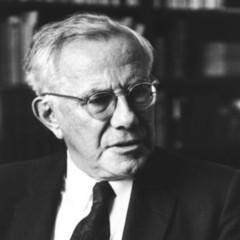
Paul Tillich
Paul Tillich

Paul Tillich (August 20, 1886 - October 22, 1965) was a German-American philosopher and theologian known for his profound contributions to religious philosophy, particularly on the concept of religious existence. His ideas have had a significant impact on 20th-century religious philosophy, theology, and theological ethics. more

You May Also Like

“Miller believes, like many theists, that religion brings us beyond the bounds of materialism. (Ironically he insists on a material explanation [evolution] for our existence.) However, he fails to explain how religion does this. Will religion enable us to overcome Heisenberg's Uncertainty Principle? Will the secrets of Miller's black box of quantum mechanics be revealed? Will chance and chaos be things of the past? If religion can't help us solve these mysteries, take us beyond the bounds of our material understanding, then Miller's belief is just so much wishful thinking. However, during one of his more coherent, non-blonde moments, Miller makes one of his strongest points: Science only concerns itself with the material universe, so we must look beyond science if we are to have morals. I can't say I disagree. However, morals don't have to come from an imaginary sky daddy. They could be rationally conceived and practiced to create an orderly society. And, why should science limit itself to the material universe? Morals can be tried and tested; bad morals can be weeded out while good morals are preserved. Such has already happened. Consider the fact that most parents no longer obey God's command to kill their children when they misbehave. Yet, those same parents abstain from stealing and adultery.”

“By setting such strong, harsh dichotomies God taught Israel that any assimilation to pagan idolatry is intolerable. It was His way of preserving Israel’s spiritual health and posterity. God knew that if these Canaanite children were allowed to live, they would spell the undoing of Israel. The killing of the Canaanite children not only served to prevent assimilation to Canaanite identity but also served as a shattering, tangible illustration of Israel’s being set exclusively apart for God.”

“After an injunction had been judicially intimated to me by this Holy Office, to the effect that I must altogether abandon the false opinion that the sun is the center of the world and immovable, and that the earth is not the center of the world, and moves, and that I must not hold, defend, or teach in any way whatsoever, verbally or in writing, the said false doctrine, and after it had been notified to me that the said doctrine was contrary to Holy Scripture — I wrote and printed a book in which I discuss this new doctrine already condemned, and adduce arguments of great cogency in its favor, without presenting any solution of these, and for this reason I have been pronounced by the Holy Office to be vehemently suspected of heresy, that is to say, of having held and believed that the Sun is the center of the world and immovable, and that the earth is not the center and moves: Therefore, desiring to remove from the minds of your Eminences, and of all faithful Christians, this vehement suspicion, justly conceived against me, with sincere heart and unfeigned faith I abjure, curse, and detest the aforesaid errors and heresies, and generally every other error, heresy, and sect whatsoever contrary to the said Holy Church, and I swear that in the future I will never again say or assert, verbally or in writing, anything that might furnish occasion for a similar suspicion regarding me; but that should I know any heretic, or person suspected of heresy, I will denounce him to this Holy Office, or to the Inquisitor or Ordinary of the place where I may be. Further, I swear and promise to fulfill and observe in their integrity all penances that have been, or that shall be, imposed upon me by this Holy Office. And, in the event of my contravening, any of these my promises and oaths, I submit myself to all the pains and penalties imposed and promulgated in the sacred canons and other constitutions, general and particular, against such delinquents.”

“It is most certainly not the function of the Holy See to introduce Church reforms. The first duty of the Pope is to act as primary bishop, to watch over the traditions of the Church—her dogmatic, moral and liturgical traditions.”17”

“When, during and after the Reformation, the universities lost their status as so many autonomous parts of the universal church, they lost their independence correspondingly. In Protestant Europe, they came under the jurisdiction of the national churches and of the rapacious national monarchies; in Catholic Europe --although to a lesser extent--they came under the jurisdiction of the reinvigorated and consolidated Papacy, and of the sovereigns who, as in Spain and France, made royal influence over the church establishment within their realms a condition of their support for the Roman cause. The dissolution of medieval universalism meant that learning, like nearly everything else, was forced to submit to new or more rigid denominations. With the complete or partial secularization of society which followed upon the French Revolutionary era, in nearly every country except Britain, the universities were stripped of what remained of their old rights and became little better than state corporations.”

“How much less, then, is the disorder to be tolerated that arises when a Christian leaves his office and takes upon him a temporal office, or when a bishop or pastor leaves his office and takes upon him the office of a prince or judge; or, on the other hand, when a prince takes up the office of a bishop and lets his princely office go? Even today this shameful disorder rages and rules in the whole papacy, contrary to their own canons and laws.”