Quotessence
Home / Quotes / Quote by Samuel Beckett

Quote by Samuel Beckett

“In reality I said nothing at all, but I heard a murmur, something gone wrong with the silence, and I pricked up my ears, like an animal I imagine, which gives a start and pretends to be dead.”
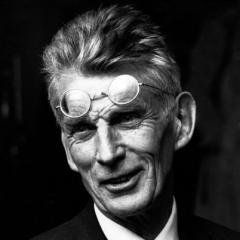
Quote by Samuel Beckett

Book:Molloy

Work

Molloy

Molloy is a work of postmodern literature known for its stream-of-consciousness style and its exploration of themes such as identity, language, and the absurd. The story follows the title character, Molloy, as he grapples with the meaning of existence and his own place in the world. more

Author

Samuel Beckett
Samuel Beckett

Samuel Beckett was an Irish novelist, playwright, and poet, widely regarded as one of the most influential writers of the 20th century. His works are characterized by their minimalist style, existential themes, and use of language. His most famous works include 'Waiting for Godot' and 'Molloy'. Beckett was awarded the Nobel Prize in Literature in 1969. more

You May Also Like

“The acrid odor of overloaded circuitry permeated the air, the horrid smell witness that at least one of his senses was working as sights and sounds became one with the unknown. Eventually he collapsed to the floor, wondering if he'd wake up in mortality. Then the muddled spectra went black, the silence that followed only possible in the deepest sectors of space. Or death.”

“If you want the light, like you say you do, then why do you keep it strangled in the dark? If you preach love, like you strive to, why do you run away from practising? My love, the universe you fumble for doesn’t exist, if you don’t start from within. Before you, all that I can be is eyes and heart. And all that I can do is to remain by your side, for I can’t love you any less than the more I do now.”

“In 2011, actor Johnny Depp told the November issue of Vanity Fair that he felt participating in a photoshoot was akin to rape. "Well, you just feel like you're being raped somehow. Raped . . . It feels like a kind of weird - just weird, man. But whenever you have a photo shoot or something like that, it's like - you just feel dumb. It's just so stupid," he said. Likening instances of being flustered or uneasy to the often life-shattering experience of rape has become a far too common comparison in modern lexicon. The phrase "Facebook rape" is perhaps the most widely used, which implies one person has posted on another person's Facebook account - usually something intended to embarrass the person. But the casual, flippant use of the term "rape" in instances that do not involve sexual violence is highly problematic in that it trivialises one of the most despicable invasions of a human being. Desensitising the masses to the term "rape" is just another way the conversation surrounding sexual assault is derailed or diluted in society. Rape is, and should be considered universally, as a serious societal sickness that occurs within the "toxic silence" that surrounds sexual assault as Tara Moss put so elegantly in her recent Q&A appearance. Further to that, the use of the term can be a trigger for rape survivors in that it may jolt terrifying memories of their own experience. According to the Australian Institute of Family Studies, up to 57 per cent of rape survivors suffer post-traumatic stress disorder in their lifetime, with "triggers" including inflammatory words like rape causing deeply traumatic recollections. Beware desensitising the term "rape", Newcastle Herald, June 6, 2014”

“At the same time all the houses round about promptly took part in this silence, and so did the darkness above them, reaching as far as the stars. And the footsteps of invisible passers-by, whose course I had no wish to guess at, the wind that kept on driving against the other side of the street, the gramophone singing behind closed windows in some room - they made themselves heard in this silence, as if they had owned it for ever and ever.”