Quotessence
Home / Quotes / Quote by Peter Mayle

Quote by Peter Mayle

“Apart from the peace and emptiness of the landscape, there is a special smell about winter in Provence which is accentuated by the wind and the clean, dry air. Walking in the hills, I was often able to smell a house before I could see it, because of the scent of woodsmoke coming from an invisible chimney. It is one of the most primitive smells in life, and consequently extinct in most cities, where fire regulations and interior decorators have combined to turn fireplaces into blocked-up holes or self-consciously lit "architectural features." The fireplace in Provence is still used - to cook on, to sit around, to warm the toes, and to please the eye - and fires are laid in the early morning and fed throughout the day with scrub oak from the Luberon or beech from the foothills of Mont Ventoux. Coming home with the dogs as dusk fell, I always stopped to look from the top of the valley at the long zigzag of smoke ribbons drifting up from the farms that are scattered along the Bonnieux road. It was a sight that made me think of warm kitchens and well-seasoned stews, and it never failed to make me ravenous.”

Quote by Peter Mayle

Work

A Year in Provence

Browse quotes and source details for this work. more

Author
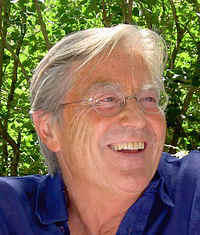
Peter Mayle
Peter Mayle

Peter Mayle, born on June 14, 1939, is a British author known for his light-hearted portrayals of rural life in France, which have won the hearts of readers worldwide. more

You May Also Like

“Blonde hair and blue eyes," she repeated. "The lavender fairy." "Now, hang on a minute!" "Just like the lavender fairy has. There's an old story about the beautiful fairy called Lavandula who was born in the wild lavender of the Lure mountain. She grew up and began to wander further from the mountain, looking for somewhere special to make her home. One day she came across the stony, uncultivated landscapes of Haute Provence, and the pitiful sight made her so sad she cried hot tears- hot mauve tears that fell into the ground and stained it. And that is where, ever afterwards, the lavender of her birthplace began to grow.”

“Daar bracht hij zijn dagen door: in de koelte van zijn werkkamer. Als een monnik, ver van het rumoer van feestende vrienden in de tuin, van het luidruchtige gestoei in het zwembad, van het aanslepende gezeur van de krekels. Daar overwon hij de eenzaamheid waar alle schrijvers van vergaan, met maagpijn pennend tot de letters voor zijn ogen begonnen te tollen.”

“She went weak in the knees and could barely walk as she followed him, trembling with fear. Her hopes for a happy future with Jordan came crashing down. Whoever had told Jordan she was free to travel under the name of Maria Brooks must have misled him.”

“In Aix we take pride in cultivating our minds, it’s our desire and tradition to do so’, claimed Maurice Gontard. He pointed out that the great Provençal poet, Frederic Mistral, had originally found Aix rather cold, but had finally declared that there was a ‘certain charm to the place’. Music had always played an important role in Aix and there were many active musical societies. The theatre was well frequented, there was a university and various local heritage and language societies to keep the past alive, to show that Aix had its own cultural identity.”

“The oblong tower of the church, with its wrought-iron steeple, caught the last reflections of the sun against the hills. This is what a cinematographer would call the golden hour, the glowing time just after the sun sinks below the horizon and before the dark sets in. It's the watercolor skies--- discreet layers of cotton-candy pink, dusky rose, and periwinkle, when the fields are their deepest green, and the wheat has a halo that rises from the surface. We were standing on the medieval ramparts, the walls that once protected this small community from the hostilities of the outside world. Just below us was a field of lavender, the rows tidy and symmetrical. Just behind, a hedge of rosemary bushes. In the distance I could make out the summit of Reillanne, golden city on a hill.”

“When we'd arrived in Céreste, our neighbor Arnaud said we should go to the Musée de Salagon, in Mane. In addition to its twelfth-century church and Gallo-Roman ruins, the museum has a wonderful medieval garden. The monks used these herbs to heal as well as to flavor. I've met many people in Provence who use herbal remedies, not because it's trendy, but because it's what their grandmothers taught them. My friend Lynne puts lavender oil on bug bites to reduce the swelling; I recently found Arnaud on his front steps tying small bundles of wild absinthe, which he burns to fumigate the house. Many of the pharmacies in France still sell licorice root for low blood pressure. We drink lemon verbena herbal tea for digestion. I also like the more poetic symbolism of the herbs. I'm planting sage for wisdom, lavender for tenderness (and, according to French folklore, your forty-sixth wedding anniversary), rosemary for remembrance. Thyme is for courage, but there is also the Greek legend that when Paris kidnapped Helen of Troy, each tear that fell to the ground sprouted a tuft of thyme. All things being equal, I prefer courage to tears in my pot roast.”