Quotessence
Home / Quotes / Quote by Stefan Zweig

Quote by Stefan Zweig

“Ich war durch meine fürchterliche Situation gezwungen, diese Spaltung in ein Ich Schwarz und ein Ich Weiß zumindest zu versuchen, um nicht erdrückt zu werden von dem grauenhaften Nichts um mich.”

Quote by Stefan Zweig

Work

Schachnovelle

Browse quotes and source details for this work. more
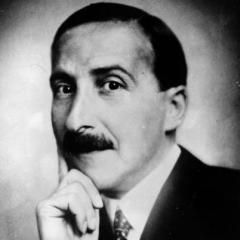
Author

Stefan Zweig
Stefan Zweig

Stefan Zweig, born on November 28, 1881 in Vienna, was an Austrian novelist, playwright, and biographer. Known for his profound psychological insights and unique narrative style, he is a significant figure in European literature at the beginning of the 20th century. more

You May Also Like

“Philip Conwell-Evans, who three years earlier had witnessed the book burning at Königsberg University with such equanimity. Choosing to operate discretely behind the scenes, Conwell-Evans had been instrumental in bringing together a number of influential British figures with leading Nazis. It was he, for instance who in December 1934, had been the driving force behind the first major dinner party Hitler ever hosted for foreigners and at which Lord Rothermere had been guest of honour. And it was now Conwell-Evans, in harness with his close friend Ribbentrop, who was masterminding the Lloyd-George expedition. 'He is so blind to the blemishes of the Germans,' Dr Jones wrote of his fellow Welshman in his diary,' as to make one see the virtues of the French.”

“Sir Barry Domvile sensed the chill as soon as he arrived in Nuremberg for the 1937 Reichsparteitag. 'Thought the SS more truculent than usual,' he observed ... And he was further disappointed when the Führer passed by him at the reception without a word. Indeed as Hitler walked along the line of British guests, he remained stiff and expressionless until introduced to Francis Yeats-Brown when he burst into smiles. Yeats-Brown's autobiography, The Lives of a Bengal Lancer (1930), had been made into a Hollywood movie (starring Gary Cooper) that had become a great favourite of Hitler's. He thought the film such a valuable demonstration of how Aryans should deal with an inferior race that he had made it compulsory viewing for the SS.”

“Thelma Cazalet MP, unlike most of the other British 'honoured guests' attending [the 1938 Reichsparteitag], was strongly anti-Nazi and had accepted Ribbentrop's invitation only because she thought it important 'to be aware of what was going on.' As she entered the dining room of the Grand Hotel on the first night, she immediately caught sight of Unity Mitford seated at the long 'British' table with her parents Lord and Lady Redesdale. 'Unity is alarmingly pretty,' she wrote in her diary, 'but I have never seen anyone so pretty with absolutely no charm in her face and a rather stupid expression.”

“When Hitler addressed the Reichstag in January 1934, he could look back on a year of achievement without parallel in German history. Within twelve months he had overthrown the Weimar Republic, substituted his personal dictatorship for its democracy, destroyed all political parties but his own, smashed the state governments and their parliaments and unified and defederalized the Reich, wiped out the labor unions, stamped out democratic associations of any kind, driven the Jews out of public and professional life, abolished freedom of speech and of the press, stifled the independence of the courts and "co-ordinated" under Nazi rule, the political, economic, cultural and social life of an ancient and cultivated people.”

“The historian Meike Wöhlert has analyzed and compared the judgments rendered by courts responsible for malicious acts of treason in five cities. Although her research only deals with registered cases and not unofficial ones, the results suggest that the telling of political jokes was a mass phenomenon beyond state control. In 61 percent of official cases, joke-tellers were let off with a warning, alcohol consumption often being cited as an extenuating circumstance. (People who had had one too many in bars were considered only partially responsible for their actions, and because most of the popular jokes that made it to court had been told in bars, the verdicts were accordingly lenient.)”

“The historical record contradicts the assumption that the Nazis sentenced large numbers of people to death during World War II for telling jokes. In the final phase of the Third Reich, some cases did receive capital sentences, but they were extreme exceptions to the rule. (We will return to them later.) The compilations of jokes that circulated in Germany after the war bore titles like Deadly Laughter and When Laughter Was Dangerous, but there is not much evidence that the jokes they contained were inevitably risky for the teller.”

“Finally, my watchers had to fess up. In embarrassed and genuinely polite tones, they said they had no other choice but to arrest me. Then they accompanied me to the prison across the way. As I entered, an extremely tall SS man leapt in front of me and asked: “Do you have any weapons?” “Why?” I responded. “Do I need any?”

“Comrades, we are going to try to cheer you up, and our sense of humor will help us in this endeavor, although the phrase gallows humor has never seemed so logical and appropriate. The external circumstances are exactly in our favor. We need only to take a look at the barbed wire fences, so high and full of electricity. Just like your expectations. And then there are the watchtowers that monitor our every move. The guards have machine guns. But machine guns won’t intimidate us, comrades. They just have barrels of guns, whereas we are going to have barrels of laughs. You may be surprised at how upbeat and cheerful we are. Well, comrades, there are goods reasons for this. It’s been a long time since we were in Berlin. But every time we appeared there, we felt very uneasy. We were afraid we’d get sent to the concentration camps. Now that fear is gone. We’re already here.”

“On April 1, armed SA men took up positions in front of Jewish businesses and tried to prevent customers from spending money in them. Some troops painted anti-Semitic slogans and Stars of David on display windows; others were content to hold up signs calling for a boycott and to curse at Jewish businessmen. Some areas also saw looting and acts of violence. All in all, this display of activism made a very negative impression on most people, and the thuggish SA men with their uneducated bellowing were left even less popular among the general population than they had been before. Although very few Germans openly declared their solidarity with their Jewish fellow citizens, the boycott did not, as it was intended to do, set German gentiles against German Jews. On the contrary, ordinary people felt sorry for them, and if reports by the Nazis, who were disappointed by the boycott, are to be believed, the amount of commerce done afterward by Jewish-owned business did not decline at all.”