Quotessence
Home / Quotes / Quote by Sophocles

Quote by Sophocles

“Who on earth, alive in the midst of so much grief as I, could fail to find his death a rich reward?”

Quote by Sophocles

Author
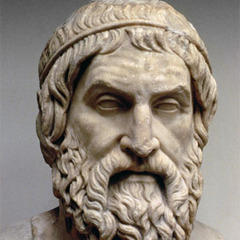
Sophocles
Sophocles

Sophocles, born in 498 BC and died in 406 BC, was a renowned Greek tragic playwright. He is one of the three greatest tragic poets of ancient Greece, alongside Aeschylus and Euripides. Sophocles' works profoundly revealed the complexity of human nature and social contradictions, exerting a profound influence on subsequent drama. more

You May Also Like

“I was particularly impressed by the varying degrees of weathering and erosion seen on the different moai, which could be telltale signs of major discrepancies in their ages. The levels of sedimentation around certain moai also impressed me. Some moai have been buried in up to an estimated six meters of sediment, or more, such that even though they are standing erect, only their chins and heads are above the current ground level. Such high levels of sedimentation could occur quickly, for instance if there were catastrophic landslides, mudflows, or possibly tsunamis washing over the island, but I could not find any such evidence (and landslides or tsunamis would tend to shift and knock over the tall statues). Rather, to my eye, the sedimentation around certain moai suggests a much more extreme antiquity than most conventional archaeologists and historians believe to be the case--or believe to be possible.”

“BUNAHAN When the last speaker of Boro falls silent, who will notice the first-grown feather of a bird’s wing? (gansuthi) or feel how far pretending to love (onsay) is from loving for the last time (onsra)? Quiet and uneasy, in an unfamiliar place (asusu) no one sees her, or listens; there is less of her than there was. The last speaker feels Boro’s world fall apart, knowledge unravels: healing plants go unseen; the bodies of animals are unreadable. With a last thought, onguboy (to love it all, from the heart), she leaves fragments of the world she held in place. We touch their husks, about to speak and about not to speak (bunhan, bunahan); awash in loss, incomplete. Note: The italicized words are from Boro, an endangered language still spoken in parts of northern India. For more on this story, see Mark Abley’s Spoken Here: Travels Among Threatened Languages.”

“Turks, like Russians and Israelites, seem to want you to see the things that show you how they have got on since Atatürk, or since the Bolshevik revolution, or since they took over Palestine. But how people have got on is actually only interesting to the country which has got on. What foreign visitors care about are the things that were there before they began to get on. I dare say foreigners in England really only want to see Stonehenge, and Roman walls and villas, and the field under which Silchester lies buried, and Norman castles and churches, and the ruins of medieval abbeys, and don't care a bit about Sheffield and Birmingham, or our model farms and new towns and universities and schools and dams and aerodromes and things.”

“How can we finally unplug in a hustling world? We often notice we simply do not have the knack for unwinding and finding moments of stillness. Learning to align our commitments to our needs or values and keeping our time budget under surveillance can be incredibly grounding and energizing. If we put boundaries around our time and energy patterns, we can succeed in leading a balanced and inspiring life without regret. (“Finally unwind”)”