Quotessence
Home / Quotes / Quote by Charles Bukowski

Quote by Charles Bukowski

“people just are not good to each other one on one. the rich are not good to the rich the poor are not good to the poor. we are afraid. our educational system tells us that we can all be big-ass winners. it hasn't told us about the gutters or the suicides. or the terror of one person aching in one place alone untouched unspoken to watering a plant. people are not good to each other. people are not good to each other. people are not good to each other. I suppose they never will be. I don't ask them to be. but sometimes I think about it.”

Quote by Charles Bukowski

Work

Love is a Dog From Hell

This book delves into the intricacies of human connections, presenting a narrative that is both emotional and thought-provoking. more

Author
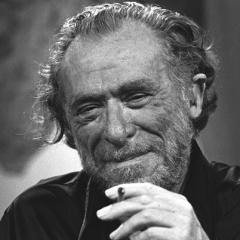
Charles Bukowski
Charles Bukowski

Charles Bukowski, born on August 16, 1920, was an influential American poet. Known for his unique style and profound depiction of the lives of the underclass in America, he is considered one of the representatives of the Beat Generation. more

You May Also Like

“Movies were America’s way of softening up the rest of the world, Hollywood relentlessly assaulting the mental defenses of audiences with the hit, the smash, the spectacle, the blockbuster, and, yes, even the box office bomb. It mattered not what story these audiences watched. The point was that it was the American story they watched and loved, up until the day that they themselves might be bombed by the planes they had seen in American movies.”

“Mayor Gayle, Commissioner Sellers, and several white reporters had reached the house before I did [after the bombing] and were standing in the dining room. After reassuring myself about my family's safety, I went to speak to them. Both Gayle and Sellers expressed their regret that "this unfortunate incident has taken place in our city." One of the trustees of my church, who is employed in the public school system of Montgomery, was standing beside me when the mayor and commissioner spoke. Although in a vulnerable position, he turned to the mayor and said: "You may express your regrets, but you must face the fact that your public statements created the atmosphere for this bombing. This is the end result of your 'get-tough' policy." Neither Mayor Gayle nor Commissioner Sellers could reply.”

“When, therefore, a man is told, “You (your inner being) are so and so, because your skull-bone is so constituted,” this means nothing else than that we regard a bone as the man's reality. To retort upon such a statement with a box on the ear — in the way mentioned above when dealing with psysiognomy — removes primarily the “soft” parts of his head from their apparent dignity and position, and proves merely that these are no true inherent nature, are not the reality of mind; the retort here would, properly speaking, have to go the length of breaking the skull of the person who makes a statement like that, in order to demonstrate to him in a manner as palpable as his own wisdom that a bone is nothing of an inherent nature at all for a man, still less his true reality.”

“The Coach’s head was oblong with tiny slits that served as eyes, which drifted in tides slowly inward, as though the face itself were the sea or, in fact, a soup of macromolecules through which objects might drift, leaving in their wake, ripples of nothingness. The eyes—they floated adrift like land masses before locking in symmetrically at seemingly prescribed positions off-center, while managing to be so closely drawn into the very middle of the face section that it might have seemed unnecessary for there to have been two eyes when, quite likely, one would easily have sufficed. These aimless, floating eyes were not the Coach’s only distinctive feature—for, in fact, connected to the interior of each eyelid by a web-like layer of rubbery pink tissue was a kind of snout which, unlike the eyes, remained fixed in its position among the tides of the face, arcing narrowly inward at the edges of its sharp extremities into a serrated beak-like projection that hooked downward at its tip, in a fashion similar to that of a falcon’s beak. This snout—or beak, rather—was, in fact, so long and came to such a fine point that as the eyes swirled through the soup of macromolecules that comprised the man’s face, it almost appeared—due to the seeming thinness of the pink tissue—that the eyes functioned as kinds of optical tether balls that moved synchronously across the face like mirror images of one another. 'I wore my lizard mask as I entered the tram, last evening, and people found me fearless,' the Coach remarked, enunciating each word carefully through the hollow clack-clacking sound of his beak, as its edges clapped together. 'I might have exchanged it for that of an ox and then thought better. A lizard goes best with scales, don’t you think?' Bunnu nodded as he quietly wondered how the Coach could manage to fit that phallic monstrosity of a beak into any kind of mask, unless, in fact, this disguise of which he spoke, had been specially designed for his face and divided into sections in such a way that they could be readily attached to different areas—as though one were assembling a new face—in overlapping layers, so as to veil, or perhaps even amplify certain distinguishable features. All the same, in doing so, one could only imagine this lizard mask to be enormous to the extent that it would be disproportionate with the rest of the Coach’s body. But then, there were ways to mask space, as well—to bend light, perhaps, to create the illusion that something was perceptibly larger or smaller, wider or narrower, rounder or more linear than it was in actuality. That is to say, any form of prosthesis designed for the purposes of affecting remedial space might, for example, have had the capability of creating the appearance of a gap of void in occupied space. An ornament hangs from the chin, let’s say, as an accessory meant to contour smoothly inward what might otherwise appear to be hanging jowls. This surely wouldn’t be the exact use that the Coach would have for such a device—as he had no jowls to speak of—though he could certainly see the benefit of the accessory’s ingenuity. This being said, the lizard mask might have appeared natural rather than disproportionate given the right set of circumstances. Whatever the case, there was no way of even knowing if the Coach wasn’t, in fact, already wearing a mask, at this very moment, rendering Bunnu’s initial appraisal of his character—as determined by a rudimentary physiognomic analysis of his features—a matter now subject to doubt. And thus, any conjecture that could be made with respect to the dimensions or components of a lizard mask—not to speak of the motives of its wearer—seemed not only impractical, but also irrelevant at this point in time.”