Quotessence
Home / Quotes / Quote by Joseph Conrad

Quote by Joseph Conrad

Work

Lord Jim

Joseph Conrad's 'Lord Jim' is a classic novel that delves into the psychological and moral complexities of its protagonist, Jim, as he navigates the treacherous waters of the South Pacific. The narrative follows Jim's journey from a young, ambitious seaman to a man grappling with the consequences of his actions and the weight of his past. The story is rich with symbolism and philosophical musings, offering readers a profound exploration of human nature and the nature of heroism. more
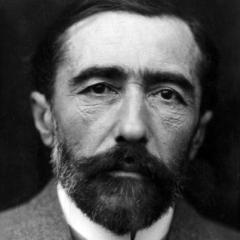
Author

Joseph Conrad
Joseph Conrad

Joseph Conrad, born on December 3, 1857 in Poland and died on August 3, 1924 in the United Kingdom, was a renowned British author of the late 19th and early 20th centuries. He is known for his profound descriptions of maritime life and his insightful explorations of human nature. more

You May Also Like

“...the best conclusion I was able to reach was that what we instinctively call imagination is in reality nothing less than the symbolic knowledge of that secret thread which weaves itself through our life knotted fast in all its windings, and without which we would surely be lost. But with this knowledge I realised too that this secret power also rules over us, for these same threads can be forcibly torn apart and leave us at the mercy of the dark fiend who is always ready to claim us as his own.”

“Suppose you and Pa were gone, and we were lost. Suppose we were inside of Lord of the Flies What would happen then? I wonder what my sister, who understand books better than life, would say if she were confronted with a question like this one. She's so good at explaining books and their meanings, beyond the obvious. Maybe she'd say that all those books and stories devoted to adult-less children – books like Peter Pan, The Adventures of Huckleberry Finn, that short story by García Márquez, "Light is Like Water," and of course Lord of the Flies – are nothing but desperate attempts by adults to come to terms with childhood. That although they may seem to be stories about children's worlds – worlds without adults – they are in fact stories about children's worlds – worlds without adults – they are in fact stores about an adult's world when there are children in it, about the way that children's imaginations destabilize our adult sense of reality and force us to question the very grounds of that reality. The more time one spends surrounded by children, disconnected by other adults, the more their imaginations leak through the cracks of our own fragile structures.”

“Like any currency of value, the human imagination is a coin with two inseparable sides. It is our faculty of fancy that fills the disquieting gaps of the unknown with the tranquilizing certitudes of myth and superstition, that points to magic and witchcraft when common sense and reason fail to unveil causality. But that selfsame faculty is also what leads us to rise above accepted facts, above the limits of the possible established by custom and convention, and reach for new summits on the degree of courage, determined by some incalculable combination of nature, culture, and character.”

“As we grow, we learn to evaluate and judge, to navigate the world with some discretion, and then we turn on ourselves – creating can't just be for the sake of creating anymore. It has to be good, or it has to mean something. We get scared out of our wits by the possibility of someone rejecting our creation. It bugs me that we get this way. It bugs me a lot. I think just making stuff is important. It doesn't have to be art. Making something out of your imagination, that wasn't there before you thought it up and plopped it out in your notebook or your tape recorder, puts you squarely on the side of creation. You're closer to god, or at least to the concept of a creator.”

“If you can't impress them with your argument, impress them with your actions.”