Quotessence
Home / Quotes / Quote by Confucius

Quote by Confucius

Work

The Analects

The Analects is a foundational text of Confucianism, compiling the sayings and thoughts of the ancient Chinese philosopher Confucius. It covers a range of topics including moral philosophy, governance, and social conduct. more
Author

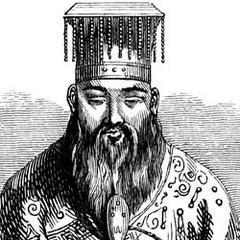
Confucius
Confucius

Confucius, also known as Kong Qiu or Zhongni, was a great philosopher, educator, and politician during the Spring and Autumn period of ancient China. He advocated for benevolence, rule of propriety, and the doctrine of the mean, and his thoughts have had a profound impact on Chinese and world culture. more

You May Also Like

“to cheat your way into a job bigger than your mind can handle is to become a fear-corroded ape on borrowed motions and borrowed time, and to settle down into a job that requires less than your mind’s full capacity is to cut your motor and sentence yourself to another kind of motion: decay - that your work is the process of achieving your values, and to lose your ambition for values is to lose your ambition to live - that your body is a machine, but your mind is its driver, and you must drive as far as your mind will take you, with achievement as the goal of your road - that the man who has no purpose is a machine that coasts downhill at the mercy of any boulder to crash in the first chance ditch, that the man who stifles his mind is a stalled machine slowly going to rust, that the man who lets a leader prescribe his course is a wreck being towed to the scrap heap, and the man who makes another man his goal is a hitchhiker no driver should ever pick up - that your work is the purpose of your life, and you must speed past any killer who assumes the right to stop you, that any value you might find outside your work, any other loyalty or love, can be only travelers you choose to share your journey and must be travelers going on their own power in the same direction.”

“The challenge lies in knowing how to bring this sort of day to a close. His mind has been wound to a pitch of concentration by the interactions of the office. Now there are only silence and the flashing of the unset clock on the microwave. He feels as if he had been playing a computer game which remorselessly tested his reflexes, only to have its plug suddenly pulled from the wall. He is impatient and restless, but simultaneously exhausted and fragile. He is in no state to engage with anything significant. It is of course impossible to read, for a sincere book would demand not only time, but also a clear emotional lawn around the text in which associations and anxieties could emerge and be disentangled. He will perhaps only ever do one thing well in his life. For this particular combination of tiredness and nervous energy, the sole workable solution is wine. Office civilisation could not be feasible without the hard take-offs and landings effected by coffee and alcohol.”

“We have a task before us which must be speedily performed. We know that it will be ruinous to make delay. The most important crisis of our life calls, trumpet-tongued, for immediate energy and action. We glow, we are consumed with eagerness to commence the work, with the anticipation of whose glorious result our whole souls are on fire. It must, it shall be undertaken to-day, and yet we put it off until to-morrow; and why? There is no answer, except that we feel perverse, using the word with no comprehension of the principle. To-morrow arrives, and with it a more impatient anxiety to do our duty, but with this very increase of anxiety arrives, also, a nameless, a positively fearful, because unfathomable, craving for delay. This craving gathers strength as the moments fly. The last hour for action is at hand. We tremble with the violence of the conflict within us, — of the definite with the indefinite — of the substance with the shadow. But, if the contest have proceeded thus far, it is the shadow which prevails, — we struggle in vain. The clock strikes, and is the knell of our welfare. At the same time, it is the chanticleer-note to the ghost that has so long overawed us. It flies — it disappears — we are free. The old energy returns. We will labor now. Alas, it is too late!”

“This world is a place of business. What an infinite bustle! I am awaked almost every night by the panting of the locomotive. It interrupts my dreams. There is no sabbath. It would be glorious to see mankind at leisure for once. It is nothing but work, work, work. I cannot easily buy a blank-book to write thoughts in; they are commonly ruled for dollars and cents. An Irishman, seeing me making a minute in the fields, took it for granted that I was calculating my wages. If a man was tossed out of a window when an infant, and so made a cripple for life, or scared out of his wits by the Indians, it is regretted chiefly because he was thus incapacitated for—business! I think that there is nothing, not even crime, more opposed to poetry, to philosophy, ay, to life itself, than this incessant business.”