Quotessence
Home / Quotes / Quote by Arthur Miller

Quote by Arthur Miller

Work

The Crucible

Arthur Miller's 'The Crucible' is a dramatic retelling of the infamous Salem witch trials that occurred in colonial Massachusetts. The story delves into the paranoia and societal breakdown that led to the persecution of innocent individuals accused of witchcraft. The play serves as an allegory for the McCarthyism era in the United States, highlighting the dangers of witch hunts and the loss of personal freedoms under the guise of public safety. more
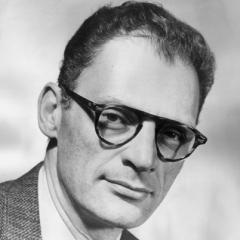
Author

Arthur Miller
Arthur Miller

A renowned American playwright, known for his profound social criticism and character development. His works include 'Death of a Salesman' and 'All My Sons'. more

You May Also Like

“What appears in the former statue of Apollo, however, cannot simply be equated with the Olympian of the same name, who had to ensure light, contours, foreknowledge and security of form in his days of completeness. Rather, as the poem's title implies, he stands for something much older, something rising from prehistoric sources. He symbolizes a divine magma in which something of the first ordering force, as old as the world itself, becomes manifest. There is no doubt that memories of Rodin and his cyclopian work ethic had an effect on Rilke here. During his work with the great artist, he experienced what it means to work on the surfaces of bodies until they are nothing but a fabric of carefully shaped, luminous, almost seeing 'places'. A few years earlier, he had written of Rodin's sculptures that 'there were endless places, and none of them did not have something happening in them'. Each place is a point at which Apollo, the god of forms and surfaces, makes a visually intense and haptically palpable compromise with his older opponent Dionysus, the god of urges and currents. That this energized Apollo embodies a manifestation of Dionysus is indicated by the statement that the stone glistens 'like wild beasts' fur'.”

“- Rodin'in Yaşlı Fahişe (La Belle qui fut heaulmière) heykeli için - Herkes güzel bir kıza bakıp güzel bir kız görebilir. Bir sanatçı o güzel kıza bakıp yaşlandığında nasıl biri olacağını görür. Daha da iyi bir sanatçı, yaşlı bir kadına bakıp gençliğinde nasıl güzel bir kız olduğunu görebilir. Ama büyük bir sanatçı -bir usta- ki Auguste Rodin de aynen öyleydi; yaşlı bir kadına bakıp onu aynen olduğu şekilde resmedebilir... ve izleyiciyi onun bir zamanlar nasıl güzel bir genç kız olduğunu görmeye zorlayabilir... üstelik, bir armadillo kadar hassas olan herkesin, hatta senin bile, bu güzel genç kızın hâlâ hayatta olduğunu, yaşlanıp çirkinleşmediğini, sadece çökmüş bedeninin içinde hapis kaldığını görmesini sağlayabilir. Senin, hiçbir kızın kendi kalbinde, geçen acımasız zaman ona ne yapmış olursa olsun on sekiz yaşından fazla büyümediğini hissetmeni, o sessiz, sonsuz trajediyi algılamanı sağlayabilir.”

“As we know, Rilke, under the influence of Auguste Rodin, whom he had assisted between 1905 and 1906 in Meudon as a private secretary, turned away from the art nouveau-like, sensitized-atmospheric poetic approach of his early years to pursue a view of art determined more strongly by the priority of the object. The proto-modern pathos of making way for the object without depicting it in a manner 'true to nature', like that of the old masters, led in Rilke's case to the concept of the thing-poem - and thus to a temporarily convincing new answer to the question of the source of aesthetic and ethical authority. From that point, it would be the things themselves from which all authority would come - or rather: from this respectively current singular thing that turns to me by demanding my full gaze. This is only possible because thing-being would now no longer mean anything but this: having something to say.”

“We know from accounts of Rilke's life that his stay in Rodin's workshops taught him how modern sculpture had advanced to the genre of the autonomous torso. The poet's view of the mutilated body thus has nothing to do with the previous century's Romanticism of fragments and ruins; it is part of the breakthrough in modern art to the concept of the object that states itself with authority and the body that publicizes itself with authorization.”

“Remind me who you are,” he said in a gentler tone, almost a please. “How we know each other.” “Okay,” she began. “I’m Savannah Evans, a grad student and teaching assistant who teaches English at a college in Cambridge. I applied to the colony to work on my poetry and arrived six weeks ago. “We’ve spoken many times. You’ve praised my work, which I find a great honor as I’m a fan of your art.”