Quotessence
Home / Quotes / Quote by Maya Angelou

Quote by Maya Angelou

Work

All God's Children Need Traveling Shoes

This novel delves into the lives of a family as they navigate the complexities of their own identities and their place in a changing world. The story follows their journey of self-discovery and the challenges they face in adapting to new environments and understanding their cultural heritage. more

Author
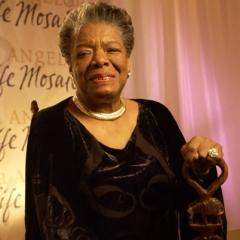
Maya Angelou
Maya Angelou

Maya Angelou was an American author, poet, playwright, actress, and lecturer, known for her profound exploration of race, gender, and culture in her work. Her autobiographical works, including 'I Know Why the Caged Bird Sings,' which detailed her early life of poverty and sexual exploitation, have gained widespread acclaim. more

You May Also Like

“Nothing had come easy to him. School, sports, or girls... it seemed to Oswald that everyone else had come into this world with a set of instructions but him. From the beginning he had always felt like a pair of white socks and brown shoes in a roomful of tuxedos. He had never really gotten a break in life, and now it was all over.”

“For a moment, Layla glanced at Amar's journals, but she could barely make sense of his handwriting. Each deciphered sentence threatened to unravel her understanding of him and carried with it the threat of more secrets. It did not matter that she was his mother. What she could ever hope to know of him was just a glimpse -- like the beam of a lighthouse skipping out, only one stretch of waves visible at a time, the rest left in the unknowable dark.”

“If you want to leave something for your children, leave a better world, not heaps of money, because at the rate our ancestors screwed up this world and at the rate we are sustaining their stupidity in our pursuit of limitless productivity, soon all the money in the world will not be enough to save our children from imminent disaster.”

“Another form of projection is the projection of one’s own problems on the children. First of all such projection takes place not infrequently in the wish for children. In such cases the wish for children is primarily determined by projecting one’s own problem of existence on that of the children. When a person feels that he has not been able to make sense of his own life, he tries to make sense of it in terms of the life of his children. But one is bound to fail within oneself and for the children. The former because the problem of existence can be solved by each one only for himself, and not by proxy; the latter because one lacks in the very qualities which one needs to guide the children in their own search for an answer. Children serve for projective purposes also when the question arises of dissolving an unhappy marriage. The stock argument of parents in such a situation is that they cannot separate in order not to deprive the children of the blessings of a unified home. Any detailed study would show, however, that the atmosphere of tension and unhappiness within the “unified family” is more harmful to the children than an open break would be-which teaches them at least that man is able to end an intolerable situation by a courageous decision.”