Quotessence
Home / Quotes / Quote by Yukio Mishima

Quote by Yukio Mishima

“The law is an accumulation of tireless attempts to block a man's desire to change life into an instant of poetry. Certainly it would not be right to let everybody exchange his life for a line of poetry written with a splash of blood. But the mass of men, lacking valor, pass away their lives without ever feeling the least touch of such a desire.”

Quote by Yukio Mishima

Work

Runaway Horses

A gripping narrative following a group of horses that embark on an unexpected journey, intertwining their fates with those of the people they encounter. more

Author

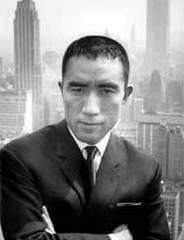
Yukio Mishima
Yukio Mishima

Yukio Mishima was a Japanese author and playwright, a prominent figure in post-war Japanese literature. His works, characterized by a fusion of traditional Japanese aesthetics and modernist techniques, often explored themes of tradition, ritual, and the samurai code. more

You May Also Like

“I've been mistaken to assume that in this little village in the spring, so like a dream or a poem, life is a matter only of the singing birds, the falling blossoms, and the bubbling springs. The real world has crossed mountains and seas and is bearing down even on this isolated village, whose inhabitants have doubtless lived here in peace down the long stretch of years ever since they fled as defeated warriors from the great clan wars of the twelfth century. Perhaps a millionth part of the blood that will dye the wide Manchurian plains will gush from this young man's arteries, or seethe forth at the point of the long sword that hangs at his waist. Yet here this young man sits, beside an artist for whom the sole value of human life lies in dreaming. If I listen carefully, I can even hear the beating of his heart, so close are we. And perhaps even now, within that beat reverberates the beating of the great tide that is sweeping across the hundreds of miles of that far battlefield. Fate has for a brief and unexpected moment brought us together in this room, but beyond that it speaks no more.”

“14. Hateful Things: Someone has suddenly fallen ill and one summons the exorcist. Since he is not home, one has to send messages to look for him. After one has had a long fretful wait, the exorcist finally arrives, and with a sigh of relief one asks him to start his incantations. But perhaps he has been exorcising too many evil spirits recently; for hardly has he installed himself and begun praying when his voice becomes drowsy. Oh, how hateful!”

“Knowing that it is the earth we tread, we learn to tread carefully, lest it be rent open. Realizing that it is the heavens that hang above us, we come to fear the echoing thunderbolt. The world demands that we battle with others for the sake of our own reputation, and so we undergo the sufferings bred of illusion. While we live in this world with its daily business, forced to walk the tightrope of profit and loss, true love is an empty thing, and the wealth before our eyes mere dust.”

“...He said defensively, "But from now on, Japan is sure to develop." "Japan's headed for a fall," the man said coolly. Say a thing like that in Kumamoto and you'd get a punch in the nose, or be called a traitor. The atmosphere Sanshiro grew up in left no room in his head for such an idea. Just because he was young, was the man having some fun at his expense? The man kept on grinning. Yet his way of talking was perfectly composed. Not knowing what to think, Sanshiro held his tongue. His companion went on, "Tokyo is bigger than Kumamoto. Japan is bigger than Tokyo. And what's bigger than Japan is..." He paused and looked at Sanshiro, who was listening intently. "...the inside of your head. That's bigger than Japan. Don't let yourself get bogged down. You may believe your way of thinking is for the good of the nation, but you could actually be bringing it down." When he heard this, Sanshiro felt he had indeed left Kumamoto. And he realized, too, what a small person his Kumamoto self had been.”

“Giây phút nhìn con thở yếu ớt vì uống quá nhiều thuốc ngủ, cha tưởng chừng tim mình ngừng đập. Dù thế nào, cha cũng phải vững vàng trước mặt mẹ con, nhưng lòng cha hoàn toàn trống rỗng, như thể trái tim đã đi đâu mất rồi. Cha cuống cuồng gọi xe cấp cứu, nhưng bác sĩ nói rằng coi như hết hy vọng, rằng có thể con sẽ phải sống thực vật suốt đời. Dù vậy, họ vẫn dốc lòng cứu con. Con còn ít tuổi, các y bác sĩ đã cố gắng hết sức để mang con trở về bằng mọi giá. Nhìn cảnh ấy, cha cảm động biết chừng nào. Và con hồi sinh một cách thần kỳ như để đáp lại nhiệt huyết của mọi người. Đúng lúc ấy cha đã nghĩ, người tốt hay xấu đều không còn quan trọng...”

“People called Mother a beauty, when she was young. I remember her very well in those days—until I was fourteen or fifteen she was as beautiful as ever. When I compare that memory of her with Satsuko, the contrast is really striking. Satsuko is also called a beauty. That was the main reason why Jokichi married her. But between these two beauties, between the 1890’s and now, what a change has taken place in the physical appearance of the Japanese woman! For example, Mother’s feet were beautiful too, but Satsuko’s have an altogether different kind of beauty. They hardly seem to belong to a woman of the same race. Mother had dainty feet, small enough to nestle in the palm of my hand, and as she tripped along in her straw sandals she took extremely short, mincing steps with her toes turned in. (I am reminded that in my dream Mother’s feet were bare except for her sandals, even though she was dressed to go visiting. Perhaps she was deliberately showing off her feet to me.) All Meiji women had that pigeon-like walk, not just beauties. As for Satsuko’s feet, they are elegantly long and slender; she boasts that ordinary Japanese shoes are too wide for her. On the contrary, my mother’s feet were fairly broad, rather like those of the Bodhisattva of Mercy in the Sangatstudo in Nara. Also, the women of their day were short in stature. Women under five feet were not uncommon. Having been born in the Meiji era, I am only about five feet two myself, but Satsuko is an inch and a half taller.”

“Светлината блясва в човешкия живот само за най-кратък миг, вероятно за броени секунди. Ако тази светлина помръкне, без да си успял да доловиш откровението, което тя съдържа, втори шанс няма. Вероятно ще ти се наложи да изживееш остатъка от живота си в безнадеждните дълбини на самотата и съжалението. В този сумрачен свят вече не се стремиш към нищо и не очакваш нищо. Носиш в себе си само изсъхналия труп на онова, което е трябвало да бъде.”