Quotessence
Home / Quotes / Quote by Jean Baudrillard

Quote by Jean Baudrillard

“Such is the paradox of all thought which disputes the validity of the real: when it sees itself robbed of its own concept. Events, bereft of meaning in themselves, steal meaning from us. They adapt to the most fantastical hypotheses, just as natural species and viruses adapt to the most hostile environments. They have an extraordinary mimetic capacity: no longer is it theories which adapt to events, but the reverse. And, in so doing, they mystify us, for a theory which is verified is no longer a theory. It's terrifying to see the idea coincide with the reality. These are the death-throes of the concept. The epiphany of the real is the twilight of its concept. We have lost that lead which ideas had over the world, that distance which meant that an idea remained an idea. Thought has to be exceptional, anticipatory and at the margin -- has to be the projected shadow of future events. Today, we are lagging behind events. They may sometimes give the impression of receding; in fact, they passed us long ago. The simulated disorder of things has moved faster than we have. The reality effect has succumbed to acceleration --anamorphosis of speed. Events, in their being, are never behind themselves, are always out ahead of their meaning. Hence the delay of interpretation, which is now merely the retrospective form of the unforeseeable event.”

Quote by Jean Baudrillard

Work

The Perfect Crime

Browse quotes and source details for this work. more

Author
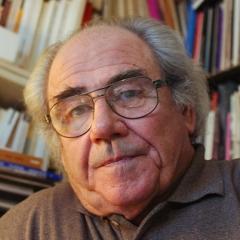
Jean Baudrillard
Jean Baudrillard

Jean Baudrillard was a French philosopher known for his critical studies on consumerism, media, and semiotics. His theories have had a profound impact on postmodernism and cultural studies. more

You May Also Like

“Here were the somatic messages that fed the cauldron; cell reactions by the incredible billion, organic cries, the muted drone of muscletone, sensory sub-currents, blood-flow, the wavering superheterodyne of blood pH ... all whirling and churning in the balancing pattern that formed the girl's psyche. The never-ending make-and-break of synapses contributed a crackling hail of complex rhythms. Packed in the changing interstices were broken images, half-symbols, partial references ... The ionised nuclei of thought.”

“In consciousness, all realities exist only because the mind is in movement. When the mind becomes completely still, then the reality made possible by the senses, memories, ideas, fears, hopes, and dreams comes to an end. And so does conflict..”

“1)In the simplest formulation, when we use a metaphor we have two thoughts of different things active together and supported by a single word, or phrase, whose meaning is a resultant of their interaction." ~ I. A. Richards 2)We believe a scientist because he can substantiate his remarks, not because he is eloquent and forcible in his enunciation. In fact, we distrust him when he seems to be influencing us by his manner. 3)Contempt is a well-recognized defensive reaction. 4)It is never what a poem says that matters, but what it is. 5)Thought is metaphoric, and proceeds by comparison, and the metaphors of language derive therefrom. I. A. Richards”

“How does one do justice to what occasions philosophical wonder in us without conferring false sublimity upon it? We said that what occasions Frege’s wonder—the absoluteness of the logical order—seems to him to be such that it cannot possibly be implicated in our dependence upon language: say, in our meaning to assert p in using a proposition to say one thing rather than another, or in our using just these words rather than some others to assert it. The Tractatus (while repudiating Frege’s conception that the nature of logic may in no way be implicated in that of language) still seeks a way to hold onto the idea that in logic it is not we who express, by means of signs, what we want; rather it is the nature of the essentially necessary signs—it is logic—that asserts itself. The later Wittgenstein, as we are about to see, seeks to undo this residual subliming of the logical in the Tractatus, while in no way seeking to dissipate the sense of wonder at the illimitable depth of the logical—(what he later calls) the grammatical—that shows itself in our forms of thought and life.”