Quotessence
Home / Authors / Alexander Lowen
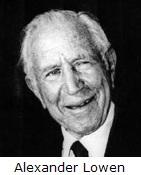
Alexander Lowen

Alexander Lowen Quotes

Author

Filter quotes by topic

Famous Alexander Lowen Quotes

“The cases described in this section (The Fear of Being) may seem extreme, but I have become convinced that they are not as uncommon as one would think. Beneath the seemingly rational exterior of our lives is a fear of insanity. We dare not question the values by which we live or rebel against the roles we play for fear of putting our sanity into doubt. We are like the inmates of a mental institution who must accept its inhumanity and insensitivity as caring and knowledgeableness if they hope to be regarded as sane enough to leave. The question who is sane and who is crazy was the theme of the novel One Flew Over The Cuckoo's Nest. The question, what is sanity? was clearly asked in the play Equus. The idea that much of what we do is insane and that if we want to be sane, we must let ourselves go crazy has been strongly advanced by R.D. Laing. In the preface to the Pelican edition of his book The Divided Self, Laing writes: "In the context of our present pervasive madness that we call normality, sanity, freedom, all of our frames of reference are ambiguous and equivocal." And in the same preface: "Thus I would wish to emphasize that our 'normal' 'adjusted' state is too often the abdication of ecstasy, the betrayal of our true potentialities; that many of us are only too successful in acquiring a false self to adapt to false realities." Wilhelm Reich had a somewhat similar view of present-day human behavior. Thus Reich says, "Homo normalis blocks off entirely the perception of basic orgonotic functioning by means of rigid armoring; in the schizophrenic, on the other hand, the armoring practically breaks down and thus the biosystem is flooded with deep experiences from the biophysical core with which it cannot cope." The "deep experiences" to which Reich refers are the pleasurable streaming sensations associated with intense excitation that is mainly sexual in nature. The schizophrenic cannot cope with these sensations because his body is too contracted to tolerate the charge. Unable to "block" the excitation or reduce it as a neurotic can, and unable to "stand" the charge, the schizophrenic is literally "driven crazy." But the neurotic does not escape so easily either. He avoids insanity by blocking the excitation, that is, by reducing it to a point where there is no danger of explosion, or bursting. In effect the neurotic undergoes a psychological castration. However, the potential for explosive release is still present in his body, although it is rigidly guarded as if it were a bomb. The neurotic is on guard against himself, terrified to let go of his defenses and allow his feelings free expression. Having become, as Reich calls him, "homo normalis," having bartered his freedom and ecstasy for the security of being "well adjusted," he sees the alternative as "crazy." And in a sense he is right. Without going "crazy," without becoming "mad," so mad that he could kill, it is impossible to give up the defenses that protect him in the same way that a mental institution protects its inmates from self-destruction and the destruction of others.”

“The most effective weapon a parent has to control a child is the withdrawal of love or its threat. A young child between the ages of three and six is too dependent on parental love and approval to resist this pressure. Robert's mother, as we saw earlier, controlled him by "cutting him out." Margaret's mother beat her into submission, but it was the loss of her father's love that devastated her. Whatever the means parents use, the result is that the child is forced to give up his instinctual longing, to suppress his sexual desires for one parent and his hostility toward the other. In their place he will develop feelings of guilt about his sexuality and fear of authority figures. This surrender constitutes an acceptance of parental power and authority and a submission to the parents' values and demands. The child becomes "good", which means that he gives up his sexual orientation in favor of one directed toward achievement. Parental authority is introjected in the form of a superego, ensuring that the child will follow his parents' wishes in the acculturation process. In effect, the child now identifies with the threatening parent. Freud says, "The whole process, on the one hand, preserves the genital organ wards off the danger of losing it; on the other hand, it paralyzes it, takes its function away from it.”

“Since the experience is different for each individual, the tension will reflect that experience. In some persons the whole lower half of the body is relatively immobilized and held in a passive state; in others the muscular tensions are localized in the pelvic floor and around the genital apparatus. If the latter sort of tension is severe, it constitutes a functional castration; for, although the genitals operate normally, they are dissociated in feeling from the rest of the body. Any reduction of sexual feeling amounts to a psychological castration. Generally the person is unaware of these muscular tensions, but putting pressure upon the muscles in the attempt to release the tension is often experienced as very painful and frightening.”