Quotessence
Home / Authors / David Suzuki
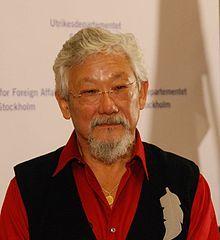
David Suzuki

David Suzuki Quotes

Professor

Filter quotes by topic

Famous David Suzuki Quotes

“Human beings are often at their best when responding to immediate crises - car accidents, house fires, hurricanes. We are less effective in the face of enormous but slow-moving crises such as the loss of biodiversity or climate change.”

“Despite the international scientific community's consensus on climate change, a small number of critics continue to deny that climate change exists or that humans are causing it. Widely known as climate change "skeptics" or "deniers," these individuals are generally not climate scientists and do not debate the science with the climate scientists.”

“Human use of fossil fuels is altering the chemistry of the atmosphere; oceans are polluted and depleted of fish; 80 per cent of Earth's forests are heavily impacted or gone yet their destruction continues. An estimated 50,000 species are driven to extinction each year. We dump millions of tonnes of chemicals, most untested for their biological effects, and many highly toxic, into air, water and soil. We have created an ecological holocaust. Our very health and survival are at stake, yet we act as if we have plenty of time to respond.”

“Because we aren't certain about the effects of GMOs, we must consider one of the guiding principles in science, the precautionary principle. Under this principle, if a policy or action could harm human health or the environment, we must not proceed until we know for sure what the impact will be. And it is up to those proposing the action or policy to prove that it is not harmful.”

“I see a world in the future in which we understand that all life is related to us and we treat that life with great humility and respect. I see us as well as social creatures, and when I began to look back and say, ‘what is the fundamental bottom line for us as social creatures?’I couldn’t believe it because it seemed so hippy dippy, but it was Love. Love is the force that makes us fully human.”