Quotessence
Home / Authors / Eckhart Tolle Books
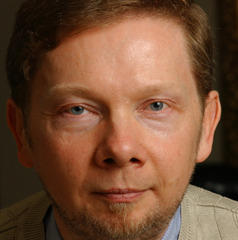
Eckhart Tolle

Eckhart Tolle Books

Author

Eine Neue Erde

A source page for quotes linked to Eckhart Tolle.
0 quotes

Related Quotes

“[The ego] cannot tell the difference between an event and its reaction to that event. Every ego is a matter of selective perception and distorted interpretation. Only through awareness—not through thinking—can you differentiate between fact and opinion. Only through awareness are you able to see: There is the situation and here is the anger I feel about it, and then realize there are other ways of approaching the situation, other ways of seeing it and dealing with it.”

“The fundamental difference between an instinctive response and an emotion is this: An instinctive response is the body’s direct response to some external situation. An emotion, on the other hand, is the body’s response to thought. Indirectly, an emotion can also be a response to an actual situation or event, but it will be a response to the event seen through the filter of a mental interpretation, the future of thought, that is to say, through the mental concepts of good and bad, like and dislike, me and mine.”

“Bet koks veiksmas yra geriau negu neveikimas, ypač jei ilgą laiką esate įstrigę nepalankioje situacijoje. Net jei suklystate, tai bent kažko išmokstate ir pagaliau klaidą ištaisote. Jei nieko nedarote, tai nieko ir neišmokstate. Gal imtis kokių nors veiksmų jums trukdo baimė? Suvokite tą baimę, stebėkite ją, sutelkite į ją savo dėmesį, būkite su ja. Kai taip elgiatės, nutraukiate ryšį tarp baimės ir savo minčių. Neleiskite, kad jūsų prote kiltų baimė. Pasikliaukite šios akimirkos jėga. Baimė jos neįveikia.”

“The great arises out of small things that are honored and cared for. Everybody's life really consists of small things. Greatness is a mental abstraction and a favorite fantasy of the ego. The paradox is that the foundation for greatness is honoring the small things of the present moment instead of pursuing the idea of greatness.”

“See if you can catch yourself complaining, in either speech or thought, about a situation you find yourself in, what other people do or say, your surroundings, your life situation, even the weather. To complain is always nonacceptance of what is. It invariably carries an unconscious negative charge. When you complain, you make yourself into a victim. When you speak out, you are in your power. So change the situation by taking action or by speaking out if necessary or possible; leave the situation or accept it. All else is madness.”

“If you cannot be at ease with yourself when you are alone, you will seek a relationship to cover up your unease. It will then reappear in some other form within the relationship, and you will probably hold your partner responsible for it. In the state of enlightenment, you *are* yourself. There is no "self" that you need to protect, defend, or feed anymore. When you are enlightened, there is one relationship you no longer have: the relationship with yourself.”

“Stress is caused by being "here" but wanting to be "there", or being in the present moment but wanting to be in the future. You can move fast, work fast, or run without projecting yourself into the future and without resisting the present. As you move, do it totally, enjoying the flow of energy at that moment. Or when you do nothing and the mind says "you should be working. You are wasting time" - observe the mind. Smile at it!”

“Once you have disidentified with yourself whether you are right or wrong makes no difference to your sense of self at all”

“The more consciousness you bring into the body, the stronger the immune system, becomes. It is as if every cell awakens and rejoices. The body loves your attention. It is also a potent form of self-healing. Most illnesses creep in when you are not present in the body. If the master is not present in the house, all kinds of shady characters will take up residence there. When you inhabit your body, it will be hard for unwanted guests to enter.”

“With every kind of waiting, you unconsciously create inner conflict between where you don't want to be (now) and where you want to be (the projected future). Give up waiting as a state of mind. When you catch yourself slipping into waiting, snap out of it. Come into the present moment. Just be, and enjoy being. If you are present, there is never any need for you to wait for anything.”

“Don't look for peace. Don't look for any other state than the one you are in now; otherwise, you will set up inner conflict and unconscious resistance. Forgive yourself for not being at peace. The moment you completely accept your non-peace, your non-peace becomes transmuted into peace. Anything you accept fully will get you there, will take you into peace. This is the miracle of surrender”

“Seen from a higher perspective, conditions are always positive. To be more precise: they are neither positive nor negative. They are as they are. And when you live in complete acceptance of what is — which is the only sane way to live — there is no “good” or “bad” in your life anymore. There is only a higher good — which includes the “bad.”

“When you are seemingly diminished in some way and remain in absolute nonreaction, not just externally but also internally, you realize that nothing real has been diminished, that through becoming "less," you become more. When you no longer defend or attempt to strengthen the form of yourself, you step out of identification with form, with mental self-image.”

“The modalities of awakened doing are acceptance, enjoyment, and enthusiasm. Each one represents a certain vibrational frequency of consciousness. You need to be vigilant to make sure that one of them operates whenever you are in engaged in doing anything at all—from the most simple task to the most complex. If you are not in the state of either acceptance, enjoyment, or enthusiasm, look closely and you will find that you are creating suffering for yourself and others.”

“Zonder acceptatie zal ergernis je woedend maken Zonder acceptatie zal verdriet je deprimeren Zonder acceptatie zal onzekerheid je angstig maken Zonder acceptatie zal ontgoocheling je kwellen Zonder acceptatie kan liefde niet liefhebben Ja zeggen tegen wat je voelt De eerste stap in geval van lijden (verlies, verdriet, tragedie, ...) is dit lijden voelen in alle cellen van je lichaam. Als je het voelt, creëer je de gelegenheid je lijden te accepteren, 'ja' te zeggen tegen wat je voelt. Je maakt er geen mentale verhalen over, maar je voelt het rechtstreeks en je huilt eventueel als dit nodig lijkt. Je laat het lijden toe er te zijn, in een complete toestand van overgave ten opzichte van wat is. Maar wat overgave doet, kan je niet volledig in je hoofd uitleggen. Waarom, waarom, waarom... vraag je je af, maar de overgave komt alleen als je zelfs het vinden van het antwoord op het waarom loslaat! Het is niet mogelijk te weten: in complete (spirituele) overgave, omarm je de toestand 'niet weten'. Accepteer dat er diepe pijn is en dat je geen antwoord hebt en ineens komt er een opening. Je vindt ruimte midden in de pijn, een openheid, een enorm gevoel van vrede. Zo kan lijden een opening zijn naar de spirituele dimensie in haar diepste zin. Eckhart Tolle”

“Zonder acceptatie zal ergernis je woedend maken Zonder acceptatie zal verdriet je deprimeren Zonder acceptatie zal onzekerheid je angstig maken Zonder acceptatie zal ontgoocheling je kwellen Zonder acceptatie kan liefde niet liefhebben Ja zeggen tegen wat je voelt De eerste stap in geval van lijden (verlies, verdriet, tragedie, ...) is dit lijden voelen in alle cellen van je lichaam. Als je het voelt, creëer je de gelegenheid je lijden te accepteren, 'ja' te zeggen tegen wat je voelt. Je maakt er geen mentale verhalen over, maar je voelt het rechtstreeks en je huilt eventueel als dit nodig lijkt. Je laat het lijden toe er te zijn, in een complete toestand van overgave ten opzichte van wat is. Maar wat overgave doet, kan je niet volledig in je hoofd uitleggen. Waarom, waarom, waarom... vraag je je af, maar de overgave komt alleen als je zelfs het vinden van het antwoord op het waarom loslaat! Het is niet mogelijk te weten: in complete (spirituele) overgave, omarm je de toestand 'niet weten'. Accepteer dat er diepe pijn is en dat je geen antwoord hebt en ineens komt er een opening. Je vindt ruimte midden in de pijn, een openheid, een enorm gevoel van vrede. Zo kan lijden een opening zijn naar de spirituele dimensie in haar diepste zin.”

“It requires honesty to see whether you still harbor grievances, whether there is someone in your life you have not completely forgiven, an "enemy." If you do, become aware of the grievance both on the level of thought as well as emotion, that is to say, be aware of the thoughts that keep it alive, and feel the emotion that is the body's response to those thoughts. Don't try to let go of the grievance. Trying to let go, to forgive, does not work. Forgiveness happens naturally when you see that it has no purpose other than to strengthen a false sense of self, to keep the ego in place. The seeing is freeing.”

“If you think you are so enlightened," Ram Dass said, "go and spend a week with your parents." That is good advice. The relationship with your parents is not only the premordial relationship that sets the tone for all subsequent relationships, it is also a good test for your degree of Presence. The more shared past there is in a relationship, the more present you need to be; otherwise you will be forced to relive the past again and again.”

“When you don't cover up the world with words and labels, a sense of the miraculous returns to your life that was lost a long time ago when humanity, instead of using thought, became possessed by thought. A depth returns to your life. Things regain their newness, their freshness. And the greatest miracle is the experiencing of your essential self as prior to any words, thoughts, mental labels, and images.”

“Descartes, of course, the French philosopher said: "I think therefore I am". If he had waited a little bit longer before saying anything, he could have come to the point of cessation of thinking and then he could have made the more profound statement: "I am conscious therefore I am". Thinking is only an expression of consciousness: a surface expression of consciousness.”

“I don't know" is not confusion. Confusion is "I don't know, but I should know" or "I don't know, but I need to know." When you fully accept that you don't know, you actually enter a state of peace and clarity that is closer to who you truly are than thought could ever be. Defining yourself through thought is limiting yourself.”

“Many relationships go through violent and destructive pain-body episodes at regular intervals. It is almost unbearably painful for a young child to have to witness the emotional violence of their parents' pain-bodies, and yet that is the fate of millions of children all over the world, the nightmare of their daily existence.”

“The happiness that is derived from some secondary source is never very deep. It is only a pale reflection of the joy of Being, the vibrant peace that you find within as you enter the state of nonresistance. Being takes you beyond the polar opposites of the mind and frees you from dependency on form. Even if everything were to collapse and crumble all around you, you would still feel a deep inner core of peace. You may not be happy, but you will be at peace.”

“Negativity is totally unnatural. It is a psychic pollutant, and there is a deep link between the poisoning and destruction of nature and the vast negativity that has accumulated in the collective human psyche. No other life-form on the planet knows negativity, only humans, just as no other life-form violates and poisons the Earth that sustains it. Have you ever seen an unhappy flower or a stressed oak tree? Have you some across a depressed dolphin, a frog that has a problem with self-esteem, a cat that cannot relax, or a bird that carries hatred and resentment? The only animals that may occasionally experience something akin to negativity or show signs of neurotic behavior are those that live in close contact with humans and so link into the humans mind and its insanity.”

“Another aspect of the emotional pain that is an intrinsic part of the egoic mind is a deep-seated sense of lack or incompleteness—of not being whole. In some people this is conscious; in others, unconscious. If it is conscious, it manifests as the unsettling and constant feeling of not being worthy or good enough. If it is unconscious, it will only be felt indirectly as an intense craving, wanting, and needing. In either case, people will often enter into a compulsive pursuit of ego gratification and things to identify with in order to fill this hole they feel within. So they strive after possessions, money, success, power, recognition, or a special relationship, basically so they can feel better about themselves—feel more complete. But even when they obtain all these things, they soon find that the hole is still there, that it is bottomless.”