Quotessence
Home / Authors / Fulton J. Sheen
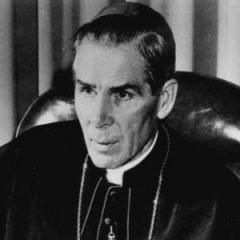
Fulton J. Sheen

Fulton J. Sheen Quotes

Televangelist

Filter quotes by topic

Famous Fulton J. Sheen Quotes

“The good repent on knowing their sin; the evil become angry when discovered. Ignorance is not the cause of evil, as Plato held; neither is education the answer to the removal of evil. These men had an intellect as well as a will; knowledge as well as intention. Truth can be known and hated; Goodness can be known and crucified. The Hour was approaching, and for the moment the fear of the people deterred the Pharisees. Violence could not be triggered against Him until He would say, 'This is your Hour.”

“As Adam lost the heritage of union with God in a garden, so now Our Blessed Lord ushered in its restoration in a garden. Eden and Gethsemane were the two gardens around which revolved the fate of humanity. In Eden, Adam sinned; in Gethsemane, Christ took humanity's sin upon Himself. In Eden, Adam hid himself from God; in Gethsemane, Christ interceded with His Father; in Eden, God sought out Adam in his sin of rebellion; in Gethsemane, the New Adam sought out the Father and His submission and resignation. In Eden, a sword was drawn to prevent entrance into the garden and thus immortalizing of evil; in Gethsemane, the sword would be sheathed.”

“He told them therefore that He was not a Teacher asking for a disciple who would parrot His sayings; He was a Saviour Who first disturbed a conscience and then purified it. But many would never get beyond hating the disturber. The Light is no boon, except to those who are men of good will; their lives may be evil, but at least they want to be good. His Presence, He said, was a threat to sensuality, avarice, and lust. When a man has lived in a dark cave for years, his eyes cannot stand the light of the sun; so the man who refuses to repent turns against mercy. No one can prevent the sun from shining, but every man can pull down the blinds and shut it out.”

“Each instinct and passion of man is amoral; it is only the abuse of these passions that makes them wrong. There is nothing wrong about hunger, but there is something wrong about gluttony; there is no sin in thirst, but there is a sin in drunkenness; there is nothing wrong with a man who seeks economic security, but there is something wrong with a man who is avaricious; there is nothing to be despised in knowledge, but there is something to be condemned in pride; there is nothing wrong with the flesh, but there is something wrong in the abuse of the flesh. Just as dirt is matter in the wrong place, so sin is flesh in the wrong place. Sex has its place in that area of life designed for its fruition, but the misuse of it outside of that natural and supernatural bond is wrong.”

“The nice people do not come to God, because they think they are good through their own merits or bad through inherited instincts. If they do good, they believe they are to receive the credit for it; if they do evil, they deny that it is their own fault. They are good through their own goodheartedness, they say; but they are bad because they are misfortunate, either in their economic life or through an inheritance of evil genes from their grandparents. The nice people rarely come to God; they take their moral tone from the society in which they live. Like the Pharisee in front of the temple, they believe themselves to be very respectable citizens. Elegance is their test of virtue; to them, the moral is the aesthetic, the evil is the ugly. Every move they make is dictated, not by a love of goodness, but by the influence of their age. Their intellects are cultivated—in knowledge of current events; they read only the bestsellers, but their hearts are undisciplined. They say that they would go to church if the Church were only better—but they never tell you how much better the Church must be before they will join it. They sometimes condemn the gross sins of society, such as murder; they are not tempted to these because they fear the opprobrium which comes to them who commit them. By avoiding the sins which society condemns, they escape reproach, they consider themselves good par excellence.”

“Strong passions are the precious raw material of sanctity. Individuals that have carried their sinning to extremes should not despair or say, “I am too great a sinner to change,” or “God would not want me.” God will take anyone who is willing to love, not with an occasional gesture, but with a “passionless passion,” a “wild tranquility.” A sinner, unrepentant, cannot love God, any more that a man on dry land can swim; but as soon as he takes his errant energies to God and asks for their redirection, he will become happy, as he was never happy before. It is not the wrong things one has already done which keep one from God; it is the present persistence in that wrong.”

“Very harmful effects can follow accepting the philosophy which denies personal guilt or sin and thereby makes everyone nice. By denying sin, the nice people make a cure impossible. Sin is most serious, and the tragedy is deepened by the denial that we are sinners…The really unforgiveable sin is the denial of sin, because, by its nature, there is now nothing to be forgiven. By refusing to admit to personal guilt, the nice people are made into scandalmongers, gossips, talebearers, and supercritics, for they must project their real if unrecognized guilt to others. This, again, gives them a new illusion of goodness: the increase of faultfinding is in direct ratio and proportion to the denial of sin.”

“He came to put a harlot above a Pharisee, a penitent robber above a High Priest, and a prodigal son above his exemplary brother. To all the phonies and fakers who would say that they could not join the Church because His Church was not holy enough, He would ask, 'How holy must the Church be before you will enter into it?' If the Church were as holy as they wanted it to be, they would never be allowed into it! In every other religion under the sun, in every Eastern religion from Buddhism to Confucianism, there must always be some purification before one can commune with God. But Our Blessed Lord brought a religion where the admission of sin is the condition of coming to Him. 'Those who are well have no need of a physician, but those who are ill.”

“It was not enough that the Son of God should come down from the heavens and appear as the Son of Man, for then He would have been only a great teacher and a great example, but not a Redeemer. It was more important for Him to fulfill the purpose of the coming, to redeem man from sin while in the likeness of human flesh. Teachers change men by their lives; Our Blessed Lord would change men by His death. The poison of hate, sensuality, and envy which is in the hearts of men could not be healed simply by wise exhortations and social reforms. The wages of sin is death, and therefore it was to be by death that sin would be atoned for.”

“The life of each and every one of us has been written. The crucifix is my autobiography. The blood is the ink. The nails the pen. The skin the parchment. On every line of that body I can trace my life. In the crown of thorns I can read my pride. In the hands that are dug with nails, I can read avarice and greed. In the flesh hanging from him like purple rags, I can read my lust. In feet that are fettered, I can find the times that I ran away and would not let him follow. Any sin that you can think of is written there.”