Quotessence
Home / Authors / Fulton J. Sheen Books
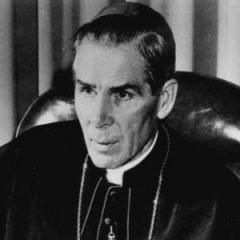
Fulton J. Sheen

Fulton J. Sheen Books

Televangelist

Life of Christ

A source page for quotes linked to Fulton J. Sheen.
0 quotes

PEACE OF SOUL

A source page for quotes linked to Fulton J. Sheen.

0 quotes

Related Quotes

“The evil in the world must not make me doubt the existence of God. There could be no evil if there were no God. Before there can be a hole in a uniform, there must be a uniform; before there is death, there must be life; before there is error, there must be truth; before there is a crime, there must be liberty and law; before there is a war, there must be peace; before there is a devil, there must be a God, rebellion against whom made the devil.”

“The Church makes no man less free than he was before. But we chiefly value freedom in order to give it away; every man who loves surrenders his freedom, whether his passion be the love of a woman, the love of a cause, or the love of God. . . Hence: "Thy will be done on earth as it is in Heaven. Everyone wants the things that only a love of God will bring to him, but most men today seek them in the wrong places. That is why no one comes to God without a revolution of the spirit; he must stop seeking his good in Godlessness.”

“All love on this earth involves choice. When, for example, a young man expresses his love to a young woman and asks her to become his wife, he is not just making an affirmation of love; he is also negating his love for anyone else. In that one act by which he chooses her, he rejects all that is not her. There is no other real way in which to prove we love a thing than by choosing it in preference to something else. Word and signs of love may be, and often are, expressions of egotism or passion; but deeds are proofs of love. We can prove we love our Lord only by choosing Him in preference to anything else.”

“The sun which warms the plant can under other conditions also wither it. The rain which nourishes the flower can under other conditions rot it. The same sun shines upon mud that shines upon wax. It hardens the mud but softens the wax. The difference is not in the sun, but in that upon which it shines. The Divine Life which shines upon a soul that loves Him, softens it into everlasting life; that same Divine Life which shines upon the slothful soul, neglectful of God, hardens it into everlasting death.”

“This I know. This I believe with all my heart. If we want a free and peaceful world, if we want to make the deserts bloom and man grow to greater dignity as a human being-we can do it! - Eleanor Roosevelt Dream lofty dreams, and as you dream, so shall you become. Your vision is the promise of what you shall at last unveil.- -John Ruskin Each of us makes his own weather, determines the color of the skies in the emotional universe which he inhabits.”

“The good repent on knowing their sin; the evil become angry when discovered. Ignorance is not the cause of evil, as Plato held; neither is education the answer to the removal of evil. These men had an intellect as well as a will; knowledge as well as intention. Truth can be known and hated; Goodness can be known and crucified. The Hour was approaching, and for the moment the fear of the people deterred the Pharisees. Violence could not be triggered against Him until He would say, 'This is your Hour.”

“As Adam lost the heritage of union with God in a garden, so now Our Blessed Lord ushered in its restoration in a garden. Eden and Gethsemane were the two gardens around which revolved the fate of humanity. In Eden, Adam sinned; in Gethsemane, Christ took humanity's sin upon Himself. In Eden, Adam hid himself from God; in Gethsemane, Christ interceded with His Father; in Eden, God sought out Adam in his sin of rebellion; in Gethsemane, the New Adam sought out the Father and His submission and resignation. In Eden, a sword was drawn to prevent entrance into the garden and thus immortalizing of evil; in Gethsemane, the sword would be sheathed.”

“He told them therefore that He was not a Teacher asking for a disciple who would parrot His sayings; He was a Saviour Who first disturbed a conscience and then purified it. But many would never get beyond hating the disturber. The Light is no boon, except to those who are men of good will; their lives may be evil, but at least they want to be good. His Presence, He said, was a threat to sensuality, avarice, and lust. When a man has lived in a dark cave for years, his eyes cannot stand the light of the sun; so the man who refuses to repent turns against mercy. No one can prevent the sun from shining, but every man can pull down the blinds and shut it out.”

“Each instinct and passion of man is amoral; it is only the abuse of these passions that makes them wrong. There is nothing wrong about hunger, but there is something wrong about gluttony; there is no sin in thirst, but there is a sin in drunkenness; there is nothing wrong with a man who seeks economic security, but there is something wrong with a man who is avaricious; there is nothing to be despised in knowledge, but there is something to be condemned in pride; there is nothing wrong with the flesh, but there is something wrong in the abuse of the flesh. Just as dirt is matter in the wrong place, so sin is flesh in the wrong place. Sex has its place in that area of life designed for its fruition, but the misuse of it outside of that natural and supernatural bond is wrong.”

“The nice people do not come to God, because they think they are good through their own merits or bad through inherited instincts. If they do good, they believe they are to receive the credit for it; if they do evil, they deny that it is their own fault. They are good through their own goodheartedness, they say; but they are bad because they are misfortunate, either in their economic life or through an inheritance of evil genes from their grandparents. The nice people rarely come to God; they take their moral tone from the society in which they live. Like the Pharisee in front of the temple, they believe themselves to be very respectable citizens. Elegance is their test of virtue; to them, the moral is the aesthetic, the evil is the ugly. Every move they make is dictated, not by a love of goodness, but by the influence of their age. Their intellects are cultivated—in knowledge of current events; they read only the bestsellers, but their hearts are undisciplined. They say that they would go to church if the Church were only better—but they never tell you how much better the Church must be before they will join it. They sometimes condemn the gross sins of society, such as murder; they are not tempted to these because they fear the opprobrium which comes to them who commit them. By avoiding the sins which society condemns, they escape reproach, they consider themselves good par excellence.”

“Strong passions are the precious raw material of sanctity. Individuals that have carried their sinning to extremes should not despair or say, “I am too great a sinner to change,” or “God would not want me.” God will take anyone who is willing to love, not with an occasional gesture, but with a “passionless passion,” a “wild tranquility.” A sinner, unrepentant, cannot love God, any more that a man on dry land can swim; but as soon as he takes his errant energies to God and asks for their redirection, he will become happy, as he was never happy before. It is not the wrong things one has already done which keep one from God; it is the present persistence in that wrong.”

“Very harmful effects can follow accepting the philosophy which denies personal guilt or sin and thereby makes everyone nice. By denying sin, the nice people make a cure impossible. Sin is most serious, and the tragedy is deepened by the denial that we are sinners…The really unforgiveable sin is the denial of sin, because, by its nature, there is now nothing to be forgiven. By refusing to admit to personal guilt, the nice people are made into scandalmongers, gossips, talebearers, and supercritics, for they must project their real if unrecognized guilt to others. This, again, gives them a new illusion of goodness: the increase of faultfinding is in direct ratio and proportion to the denial of sin.”

“He came to put a harlot above a Pharisee, a penitent robber above a High Priest, and a prodigal son above his exemplary brother. To all the phonies and fakers who would say that they could not join the Church because His Church was not holy enough, He would ask, 'How holy must the Church be before you will enter into it?' If the Church were as holy as they wanted it to be, they would never be allowed into it! In every other religion under the sun, in every Eastern religion from Buddhism to Confucianism, there must always be some purification before one can commune with God. But Our Blessed Lord brought a religion where the admission of sin is the condition of coming to Him. 'Those who are well have no need of a physician, but those who are ill.”

“It was not enough that the Son of God should come down from the heavens and appear as the Son of Man, for then He would have been only a great teacher and a great example, but not a Redeemer. It was more important for Him to fulfill the purpose of the coming, to redeem man from sin while in the likeness of human flesh. Teachers change men by their lives; Our Blessed Lord would change men by His death. The poison of hate, sensuality, and envy which is in the hearts of men could not be healed simply by wise exhortations and social reforms. The wages of sin is death, and therefore it was to be by death that sin would be atoned for.”

“Two classes of people make up the world: those who have found God, and those who are looking for Him - thirsting, hungering, seeking! And the great sinners came closer to Him than the proud intellectuals! Pride swells and inflates the ego; gross sinners are depressed, deflated and empty. They, therefore, have room for God. God prefers a loving sinner to a loveless 'saint'. Love can be trained; pride cannot. The man who thinks that he knows will rarely find truth; the man who knows he is a miserable, unhappy sinner, like the woman at the well, is closer to peace, joy and salvation than he knows.”

“First fervor is false fervor in marriage as in religion. The earliest ecstasy is not the true lasting love we seek to find and hold. That may come to us, but only after many purging trials, fidelities under stress, perseverance through discouragement and steady pursuit of our divine destiny past all the allurements of this earth. The deep, ecstatic love of some Christian fathers and mothers is a beautiful thing to see, but they have won it after passing through their Calvaries. Theirs is the true ecstasy which belongs less to youth than to old age. The first ecstasy of love is a thrill, but a somewhat of a selfish thrill. In it, the lover seeks to get from the beloved all that he will give. In the second ecstasy he tries to receive from God all that both of them can give. If love is identified with the early ecstasy alone, it will seek its prolongation in another person's presence. If it is identified with a unifying, enduring, and eternal love, it will seek the deepening of its mystery in the divine, Who puts all loves into our hearts.”

“No soul ever fell away from God without giving up prayer. Prayer is that which establishes contact with Divine Power and opens the invisible resources of heaven. However dark the way, when we pray, temptation can never master us. The first step downward in the average soul is the giving up of the practice of prayer, the breaking of the circuit with divinity, and the proclamation of one’s owns self sufficiency.”

“Those who deny guilt and sin are like the Pharisees of old who thought our Saviour had a “guilt complex” because He accused them of being whited sepulchers—outside clean, inside full of dead men’s bones. Those who admit that they are guilty are like the public sinners and the publicans of whom Our Lord said, “Amen, I say to you, that the publicans and the harlots shall go into the Kingdom of God before you” (Matt. 21:31). Those who think they are healthy but have a hidden moral cancer are incurable; the sick who want to be healed have a chance. All denial of guilt keeps people out of the area of love and, by inducing self-righteousness, prevents a cure. The two facts of healing in the physical order are these: A physician cannot heal us unless we put ourselves into his hands, and we will not put ourselves into his hands unless we know that we are sick. In like manner, a sinner’s awareness of sin is one requisite for his recovery; the other is his longing for God. When we long for God, we do so not as sinners, but as lovers.”

“A spirit of license makes a man refuse to commit himself to any standards. The right time is the way he sets his watch. The yardstick has the number of inches that he wills it to have. Liberty becomes license, and unbounded license leads to unbounded tyranny. When society reaches this stage, and there is no standard of right and wrong outside of the individual himself, then the individual is defenseless against the onslaught of cruder and more violent men who proclaim their own subjective sense of values. Once my idea of morality is just as good as your idea of morality, then the morality that is going to prevail is the morality that is stronger.”

“But even though there be scandals from within and persecution from without, the members of His Kingdom need never fear that it will perish--for He has founded it upon a Rock against which the gates of hell cannot prevail, and He will be with it all days even to the consummation of the world.”

“All love tends to become like that which it loves. God loved man; therefore He became man. For nine months her own body was the natural Eucharist, in which God shared communion with human life, thus preparing for that greater Eucharist when human life would commune with the Divine. Mary’s joy was to form Christ in her own body; her joy now is to form Christ in our souls. In this Mystery, we pray to become pregnant with the Christ spirit, giving Him new lips with which He may speak of His Father, new hands with which He may feed the poor, and a new heart with which He may love everyone, even enemies.”

“Make this experiment whether you believe in God or not. At your first opportunity, stop in a Catholic Church for a visit. You need not believe, as we Catholics do, that Our Lord is really and truly present in the tabernacle. But just sit there for an hour, and within that hour you will experience a surpassing peace the like of which you never before enjoyed in your life. You will ask yourself as a sensationalist once asked me when we made an all-night vigil of adoration in the Basilica of Sacre Coeur in Paris: “What is it that is in that church?” Without voice or argument or thundering demands, you will have an awareness of something before which your spirit trembles — a sense of the Divine.”

“A dying man asked a dying man for eternal life; a man without possessions asked a poor man for a Kingdom; a thief at the door of death asked to die like a thief and steal Paradise. One would have thought a saint would have been the first soul purchased over the counter of Calvary by the red coins of Redemption, but in the Divine plan it was a thief who was the escort of the King of kings into Paradise. If Our Lord had come merely as a teacher, the thief would never have asked for forgiveness. But since the thief's request touched the reason of His coming to earth, namely, to save souls, the thief heard the immediate answer: 'I promise thee, this day thou shalt be With Me in Paradise' (Luke 23:43) It was the thief's last prayer, perhaps even his first. He knocked once, sought once, asked once, dared everything, and found everything. When even the disciples were doubting and only one was present at the Cross, the thief owned and acknowledged Him as Saviour.”

“Our poor human heart is flawed: it is like a cake without the frosting: the first two acts of the theatre without the climax. Even its design is marred for a small piece is missing out of the side. That is why it remains so unsatisfied: it wants life and it gets death: it wants Truth and it has to settle for an education; it craves love and gets only intermittent euphoria’s with satieties. Samples, reflections and fractions are only tastes, not mouthfuls. A divine trick has been played on the human heart as if a violin teacher gave his pupil an instrument with one string missing. God kept a part of man's heart in Heaven, so that discontent would drive him back again to Him Who is Eternal Life, All-Knowing Truth and the Abiding Ecstasy of Love.”

“In the eleven months preceding the outbreak of World War II, 211 treaties of peace were signed. Were these treaties of peace written on paper, or were they written on the hearts of men? And we must ask ourselves as we hear of treaties being written today, whether the treaties of the UN are written with the full cognizance of the fact that those who sign them are responsible before God?”

“We can think of Lent as a time to eradicate evil or cultivate virtue, a time to pull up weeds or to plant good seeds. Which is better is clear, for the Christian ideal is always positive rather than negative. A person is great not by the ferocity of his hatred of evil, but by the intensity of his love for God. Asceticism and mortification are not the ends of a Christian life; they are only the means. The end is charity. Penance merely makes an opening in our ego in which the Light of God can pour. As we deflate ourselves, God fills us. And it is God’s arrival that is the important event.”