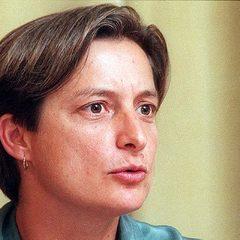
“When we say gender is performed, we usually mean that weve taken on a role or were acting in some way and that our acting or our role playing is crucial to the gender that we are and the gender that we present to the world.” WorldWayMeanActingRolesTakenGenderCrucialRole Playing Author:Judith Butler
“Revenge tries to solve the problem of vulnerability. If I strike back, I transfer vulnerability from myself to the other. And yet by striking back I produce a world in which my vulnerability to injury is increased by the likelihood of another strike. So it seems as if I'm getting rid of my vulnerability and instead locating it with the other, but actually I'm heightening the vulnerability of everyone and I'm heightening the possibility of violence that happens between us.” IfsWorldTryingProblemSeemsHappensViolencePossibilityProduceSolveRevengeStrikesVulnerabilityInjuryTransfersLikelihoodStrike Back Author:Judith Butler
“I think that many of the mobilizations against the wars waged by the US and its allies since 2001 have been non-violent and massive. We have seen them throughout European capitals and in the US, and in many other parts of the world as well. So it is not only imaginable, but already actual.” ThinkingWorldWellsHas BeensWarViolentMassiveAlliesNon ViolentMobilization Author:Judith Butler
“All of those who inhabit the world have a right to be here by virtue of their being here at all. To be here means you have a right to be here.” WorldMeanVirtue Author:Judith Butler
“Genocide is not a legitimate option. It's not ok to decide that an entire population has no right to live in the world. No matter whether these relationships are very proximate or very distant, there is no entitlement to expunge a population or to demean its basic humanity.” WorldMatterHumanityPopulationGenocideEntitlement Author:Judith Butler
“What would it mean if we lived in a world in which no one held out for the possibility of substantial political equality, or for a full cessation of colonial practices - if no one held out for those things because they were impossible?” IfsWorldMeanPoliticalPracticeImpossiblePossibilityPolitical Equality Author:Judith Butler
“Nothing is more important for transgender people than to have access to excellent health care in trans-affirmative environments, to have the legal and institutional freedom to pursue their own lives as they wish, and to have their freedom and desire affirmed by the rest of the world. This will happen only when transphobia is overcome at the level of individual attitudes and prejudices and in larger institutions of education, law, health care, and kinship.” PeopleWorldImportantHappensCareLawDesireIndividualWishLevelsAttitudeEnvironmentOvercomingPrejudiceInstitutionsAccessPursueHealth CareExcellentTransgenderTransAffirmativeKinship Author:Judith Butler
“I know that some subjective experiences of sex are very firm and fundamental, even unchangeable. They can be so firm and unchanging that we call them "innate". But given that we report on such a sense of self within a social world, a world in which we are trying to use language to express what we feel, it is unclear what language does that most effectively. I understand that "innate" is a word that conveys the sense of something hired-wired and constitutive. I suppose I would be inclined to wonder whether other vocabularies might do the job equally well.” KnowsWorldFeelsTryingWellsDoeSelfUseMightWould BeJobsLanguageGivenSocialSexWonderFundamentalsFirmReportsVocabularySubjectiveInnateSense Of SelfUnchangingUnchangeableUnclear Author:Judith Butler
“What we need are poems that interrogate the world of pronouns, open up possibilities of language and life; forms of politics that support and encourage self-affirmation.” WorldNeedsSelfFormLanguageSupportPossibilityAffirmationPronounsSelf Affirmation Author:Judith Butler
“We have to find a way of understanding how one category of sex can be "assigned" from both and another sense of sex can lead us to resist and reject that sex assignment. How do we understand that second sense of sex? It is not the same as the first - it is not an assignment that others give us. But maybe it is an assignment we give ourselves? If so, do we not need a world of others, linguistic practices, social institutions, and political imaginaries in order to move forward to claim precisely those categories we require, and to reject those that work against us?” IfsWorldWayNeedsGivingFirstsMovingPoliticalOrderSocialSexUnderstandingPracticeClaimsInstitutionsMoving ForwardRejectsCategoriesAssignmentsSocial Institutions Author:Judith Butler
“We should all have greater freedoms to define and pursue our lives without pathologization, de-realization, harassment, threats of violence, violence, and criminalization. I join in the struggle to realize such a world.” WorldShouldRealizingStruggleGreaterOur LivesViolenceThreatPursueRealizationHarassment Author:Judith Butler
“I think there is a demand. The demand is for a radical economic and political restructuring of the world. And most people would say that's impossible. And it may or may not be achieved, but I think that's less important than articulating what a just and fair world can be.” PeopleThinkingWorldMayImportantPoliticalImpossibleEconomicDemandFairsRadicalRestructuringArticulating Author:Judith Butler
“I agree completely that nothing is more important for transgender people than to have access to excellent health care in trans-affirmative environments, to have the legal and institutional freedom to pursue their own lives as they wish, and to have their freedom and desire affirmed by the rest of the world. This will happen only when transphobia is overcome at the level of individual attitudes and prejudices and in larger institutions of education, law, health care, and kinship.” PeopleWorldImportantCareDesireIndividualWishAttitudeEnvironmentOvercomingPrejudiceAgreeHealth CareExcellentTransgenderKinship Author:Judith Butler
“I did not mean to argue that gender is fluid and changeable (mine certainly is not). I only meant to say that we should all have greater freedoms to define and pursue our lives without pathologization, de-realization, harassment, threats of violence, violence, and criminalization. I join in the struggle to realize such a world.” WorldMeanRealizingStruggleViolenceThreatGenderArguingHarassment Author:Judith Butler
“When I was twelve, I was interviewed by a doctoral candidate in education and asked what I wanted to be when I grew up. I said that I either wanted to be a philosopher or a clown, and I understood then, I think, that much depended on whether or not I found the world worth philosophizing about, and what the price of seriousness might be.” ThinkingWorldSaidMightWantedFoundGrewGrew UpUnderstoodPhilosopherCandidatesTwelveClownSeriousness Book:Undoing Gender Source: Undoing Gender
“We lose ourselves in what we read, only to return to ourselves, transformed and part of a more expansive world.” WorldLosesReturnTransformed Author:Judith Butler
“I do not deny certain kinds of biological differences. But I always ask under what conditions, under what discursive and institutional conditions, do certain biological differences - and they're not necessary ones, given the anomalous state of bodies in the world - become the salient characteristics of sex.” WorldKindStatesBodyCertainAsksGivenSexDifferencesConditionsDenyCharacteristics Author:Judith Butler