Quotessence
Home / Authors / Judith Butler
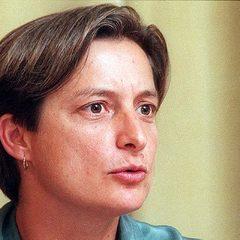
Judith Butler

Judith Butler Quotes

Philosopher

Filter quotes by topic

Famous Judith Butler Quotes

“When some people rejoin with “All Lives Matter” they misunderstand the problem, but not because their message is untrue. It is true that all lives matter, but it is equally true that not all lives are understood to matter which is precisely why it is most important to name the lives that have not mattered, and are struggling to matter in the way they deserve.”

“I don't think there's any way that war can have a place in peace. I think that peace is the active and difficult resistance to the temptation of war; it is the prerogative and the obligation of the injured. Peace is something that has to be vigilantly maintained; it is a vigilance, and it involves temptation, and it does not mean we as human beings are not aggressive. This is a mistaken way of understanding non-violence.”

“In the US the problem has been, for instance, that Nazis have rights of free expression, right? But other kinds of racist speech is not protected. And you have to link the speech to conduct or to a certain kind of threat against minority population. I know that in Europe, this kind of framework doesn't exist in the same way so it's very difficult to make the analogy.”

“There are surely many ways that [media select and contextualise events determine the boundaries of public thinking] happens, but we can note at the most obvious level the way in which forms of resistance or violence get cast as "conflicts" that assume two sides that are fighting only against one another.”

“Maybe we need to start with the rethinking of what is "west" and what is "non-west." It seems to me that there are any number of populations who already cross that divide, and we could probably point to several existing states that belong exclusively neither to one category nor to the other. Do we use these terms to designate geographical realities, geopolitical ones, or perhaps sites of power, exploitation, orientalism that move through space and time in ways that have to be tracked historically.”

“There are doubtless all kinds of ways of explaining why people want security, but I do not think we can start with the psychological explanations. Even psychological states like fear or desire for safety are conditioned by social and political forms of intimidation and scare-mongering that intensify those emotions, and even work to persuade people that nothing less than their survival is at stake.”

“It is true that one was not allowed at the time to really ask, what would lead people to do this, from what sense of political outrage or injury? And in that way, the possibility of sympathetic identification was foreclosed. That does not mean that some people took quiet pleasure in certain icons of US capitalism coming down, even though they would oppose such action on moral and political grounds.”

“I consider both the West Bank and Gaza to be colonised, even though Gaza is not occupied in the same way that the West Bank is. The Israeli government and military control all goods that pass in or out of that area, and they have restricted employment and building material that would allow Palestinians to rebuild homes and structures that were destroyed by bombardment.”

“I never did like the assertion of the "innate" inferiority or women or Blacks, and I understood that when people tried to talk that way, they were trying to "fix" a social reality into a natural necessity. And yet, sometimes we do need a language that refers to a basic, fundamental, enduring, and necessary dimension of who we are, and the sense of sexed embodiment can be precisely that.”

“We have to find a way of understanding how one category of sex can be "assigned" from both and another sense of sex can lead us to resist and reject that sex assignment. How do we understand that second sense of sex? It is not the same as the first - it is not an assignment that others give us. But maybe it is an assignment we give ourselves? If so, do we not need a world of others, linguistic practices, social institutions, and political imaginaries in order to move forward to claim precisely those categories we require, and to reject those that work against us?”

“The problem with Antigone is that she stood up to the despot Creon, but in such a way that she ended up dying. So she bought her defiance with her death. The real question I ended up asking was, "What would it mean for Antigone to have stood up to Creon and lived?" And the only way she could have lived is if she had had a serious social movement with her. If she arrived with a social movement to take down the despot, maybe it would have taken 18 days only, like in Egypt. It's really important to be able to re-situate one's rage and destitution in the context of a social movement.”

“No matter what someone else has done, it still matters how we treat people. It matters to our humanity that we treat offenders according to standards that we recognize as just. Justice is not revenge - it's deciding for a solution that is oriented towards peace, peace being the harder but more human way of reacting to injury. That is the very basis of the idea of rights.”