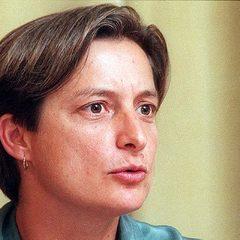
“Look, "Gender trouble" includes a critique of the idea that there are two ideal bodily forms, two ideal morphologies: the masculine and the feminine. I want to suggest that today the intersex movement is very engaged with criticizing that idea.” WantLooksTwoIdeasTodayFormTroubleMovementIdealsGenderEngagedCriticizeFeminineMasculineCritiqueIntersexMorphology Author:Judith Butler
“It's not like it's a brand new vocabulary that permits to have a new reality. It's rather a new vocabulary that lets us see that our lives have always been more complex than traditional categories allow. So, I think, you know, maybe the introduction of new words permits us to rethink what we've taken for granted about what forms bodies take, what the name is for certain kinds of sexual, intimate relations, how we think of a life.” ThinkingKnowsKindBodyRealityFormCertainNamesTakenOur LivesRelationComplexesTraditionalBrandsGrantedIntimateCategoriesPermitVocabularyIntroductionBrand NewTaken For GrantedNew Words Author:Judith Butler
“When I was young there were lesbians who said "Oh, I will free myself of all norms of masculinity, all norms of heterosexuality ". And then, they ended up in very complex relationships that were maybe full of heterosexual power dynamics or full of lesbian forms of masculinity and they became very confused.” SaidFormYoungComplexesConfusedMasculinityNormDynamicsHeterosexualityComplex Relationships Author:Judith Butler
“I think we need a politics that allows us to risk what is intelligible. To be maybe slightly unintelligible, too be slightly "illisible". To take the risk of suggesting that the human form might take another form.” ThinkingNeedsHumansMightFormRiskSuggestingHuman Form Author:Judith Butler
“There are surely many ways that [media select and contextualise events determine the boundaries of public thinking] happens, but we can note at the most obvious level the way in which forms of resistance or violence get cast as "conflicts" that assume two sides that are fighting only against one another.” ThinkingWayTwoHappensFormFightingSidesLevelsViolenceMediaEventsConflictAssumingNotesCastsDetermineObviousBoundariesResistanceSelectTwo Sides Author:Judith Butler
“We set the actors on the scene through the banal discourse of "conflict" in ways that fully deflect from the history and struggle of colonial resistance, refusing as well by that means to link the resistance to other forms of colonial resistance, their rationale, and their tactics.” WayWellsMeanFormActorsStruggleSceneConflictResistanceLinksDiscourseTacticsRationale Author:Judith Butler
“Photographs can be forms of recruitment, ways of bringing the viewer into the military, as it were. In this way, they prepare us for war, even enlist us in war, at the level of the senses, establishing a sensate regime of war.” WayWarFormLevelsMilitaryPhotographSensesRegimesViewersRecruitment Author:Judith Butler
“Perhaps we have to remember that there are forms of outrage that do not lead to any sort of mobilization, and there are ways of "registering the facts" that do not lead to outrage.” WayFactsRememberFormOutrageMobilization Author:Judith Butler
“If we are trying to account for mobilization, we have to ask, under what conditions do outraged forms of knowing lead to social mobilizations and movements? So awareness alone does not suffice, and neither does outrage.” IfsTryingDoeFormAsksSocialKnowingConditionsAwarenessMovementAccountsOutrageOutragedMobilization Author:Judith Butler
“It is true that non-governmental organisations working within strong human rights frameworks are now confounded by securitarian forms of logic and power that extend the paternalistic bias of their work in new ways.” WayHumansFormStrongRightsLogicHuman RightsNew WaysBiasFrameworkOrganisation Author:Judith Butler
“The state or global forms of power that seek to protect populations considered in danger may well extend their own power through those acts of protection.” WellsMayStatesFormDangerProtectPopulationProtection Author:Judith Butler
“The question is whether NGOs that bring protection or aid or reparation therapies are furthering the possibility of self-determination or extending a form of managerial power and paternalism.” SelfFormPossibilityDeterminationProtectionAidsTherapySelf DeterminationExtendingReparationsPaternalism Author:Judith Butler
“There are doubtless all kinds of ways of explaining why people want security, but I do not think we can start with the psychological explanations. Even psychological states like fear or desire for safety are conditioned by social and political forms of intimidation and scare-mongering that intensify those emotions, and even work to persuade people that nothing less than their survival is at stake.” PeopleThinkingWayWantKindStatesFormPoliticalDesireSocialEmotionSecuritySurvivalSafetyPsychologicalAll KindsExplanationScareStakesExplainingIntimidation Author:Judith Butler
“I do not mean to say that such institutions act unilaterally on psychic life, or that they determine certain psychic outcomes. Rather, they exploit forms of fear and insecurity that are there for any population - no political organisation of life could ever fully do away with fear and insecurity; but some work to intensify, accelerate, and make more acute forms of fear, and to provide ideological focus for such intensified fears, at which point critical thinking has a fierce rival. The critical analysis that shows precisely how those forms of fear are promulgated, and for what purpose.” ThinkingMeanShowsFormPoliticalPurposeCertainFocusInstitutionsPopulationDetermineCriticalAnalysisOutcomesInsecurityFiercePsychicsRivalsExploitsCritical ThinkingIdeologicalOrganisationAccelerateCritical Analysis Author:Judith Butler
“A different kind of pleasure surfaced in the aftermath, the pleasure of seeing the towers fall time and again, the experience of being entranced by the visual spectacle, and then also the very graphic forms of public mourning for exemplary citizens (taking place at the same time as the refusal to mourn the undocumented, the foreign, gay and lesbian lives lost there, for example). I am not sure that the guilt over the pleasure re-installed the good citizen.” KindDifferentFormFallLostPleasureSeeingExampleCitizensGayGuiltAll TimeNot SureMourningVisualsDifferent KindsTowersRefusalMournGraphicAftermathGood CitizenExemplary Author:Judith Butler
“I think maybe the destructive pleasure got turned into the destructive pleasure of war (something we see still in the images of US soldiers urinating on the dead bodies of Taliban soldiers). Something of the pleasure in destruction gets unleashed, and then becomes part of war effort rationalised first as revenge (or justice defined as revenge). But then it takes new forms, as we see now.” ThinkingFirstsStillsWarBodyFormJusticePleasureEffortDestructionSoldierRevengeDefinedDestructiveArt Of WarTalibanUnleashed Author:Judith Butler
“Surely binationalism is not love, but there is, we might say, a necessary and impossible attachment that makes a mockery of identity, an ambivalence that emerges from the decentering of the nationalist ethos and that forms the basis of a permanent ethical demand.” MightFormImpossibleIdentityDemandBasesPermanentAttachmentEthicalMockeryEthosAmbivalence Author:Judith Butler
“All of us, as bodies, are in the active position of figuring out how to live with and against the constructions - or norms - that help to form us.” HelpingBodyFormPositionActiveConstructionNorm Author:Judith Butler
“We form ourselves within the vocabularies that we did not choose, and sometimes we have to reject those vocabularies, or actively develop new ones.” SometimesFormRejectsVocabulary Author:Judith Butler
“Gender assignment is a "construction" and yet many genderqueer and trans people refuse those assignments in part or in full. That refusal opens the way for a more radical form of self-determination, one that happens in solidarity with others who are undergoing a similar struggle.” PeopleWaySelfHappensFormStruggleDeterminationRefuseGenderRadicalConstructionSelf DeterminationSolidarityRefusalTransAssignments Author:Judith Butler
“I reject totally the characterization of a transwoman as a mutilated man. First, that formulation presumes that men born into that sex assignment are not mutilated. Second, it once again sets up the feminist as the prosecutor of trans people. If there is any mutilation going on in this scene, it is being done by the feminist police force who rejects the lived embodiment of transwomen. That very accusation is a form of "mutilation" as is all transphobic discourse such as these.” PeopleIfsMenFirstsDoneFormForceSexBornScenePoliceFeministRejectsDiscourseTransAssignmentsEmbodimentAccusationBeing DoneProsecutorCharacterizationPolice ForceMutilation Author:Judith Butler
“What we need are poems that interrogate the world of pronouns, open up possibilities of language and life; forms of politics that support and encourage self-affirmation.” WorldNeedsSelfFormLanguageSupportPossibilityAffirmationPronounsSelf Affirmation Author:Judith Butler
“What we need is a political and joyous alternative to the behaviorist discourse, the Christian discourse on evil or sin, and the convergence of the two in forms of gender policing that [is] tyrannical and destructive.” NeedsTwoChristianFormPoliticalEvilSinGenderAlternativesDestructiveDiscourseJoyousConvergence Author:Judith Butler
“Neoliberalism has taken new forms since the demise of the Fordist concept of labor and with the emergence of what is understood as flexible labor. This has really come to be the dominant form for about the last 20 years.” YearsLastsFormTakenUnderstoodConceptsLaborDominantFlexibleEmergenceDemiseNeoliberalism Author:Judith Butler