Quotessence
Home / Authors / Kehinde Wiley
Kehinde Wiley

Kehinde Wiley Quotes

Painter

Filter quotes by topic

Famous Kehinde Wiley Quotes

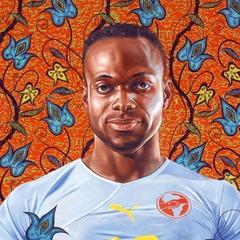
“So much of my work is defined by the difference between the figure in the foreground and the background. Very early in my career, I asked myself, "What is that difference?" I started looking at the way that a figure in the foreground works in eighteenth- and nineteenth-century European paintings and saw how much has to do with what the figure owns or possesses. I wanted to break away from that sense in which there's the house, the wife, and the cattle, all depicted in equal measure behind the sitter.”

“I enjoy Chicago as one of the great American cities. When I come here and take a taxi from the airport, I meet a young man from Somalia. I meet a young man from Eritrea who engages with this nation with a sense of hope and a sense of desire. But we also we know that there are other elements of this nation that are toxic.”

“When we talk about Orientalist painting, we're talking about painting generally from the seventeenth through the nineteenth century, and some would say even into the twentieth, that allows Europe to look at Africa, Asia Minor, or East Asia in a way that's revelatory but also as a place in which you can empty yourself out. A place in which there is no place. It's an emptiness and a location at once.”

“Let's talk about the artist's desire to go beyond the pictorial or the representational and the desire to create the abstract - the idea that painting can go beyond what is seen. What we found is that, increasingly, painting became about paint, its own material truth. When I'm talking about the way that we look at others and the way that we see ourselves increasingly, looking at others becomes its own material truth.”

“I happen to be a twin. I grew up half of my life with someone who looks and sounds like me. And I believe it's possible to hold twin desires in your head, such as the desire to create painting and destroy painting at once. The desire to look at a black American culture as underserved, in need of representation, a desire to mine that said culture and to lay its parts bare and look at it almost clinically.”

“There's always a joy in newness as a painter, and in sub-Saharan Africa, I encountered different realities with regard to light and how it bounces across the skin. The way that blues and purples come into play. In India and Sri Lanka, it was no different. It became a moment in which I had an opportunity to learn as a painter how to create the body in full form, and that's a very material and aesthetic thing. This is not conceptual. It's all an abstraction.”