Quotessence
Home / Authors / Kehinde Wiley
Kehinde Wiley

Kehinde Wiley Quotes

Painter

Filter quotes by topic

Famous Kehinde Wiley Quotes

“I think, at the L.A. County Museum of Art, I saw my first example of Kerry James Marshall, who had a very sort of heroic, oversized painting of black men in a barbershop. But it was painted on the same level and with the same urgency that you would see in a grand-scale [Anthony] van Dyck or [Diego] Velazquez. The composition was classically informed; the painting technique was masterful. And it was something that really inspired me because, you know, these were images of young, black men in painting on the museum walls of one of the more sanctified and sacred institutions in Los Angeles.”

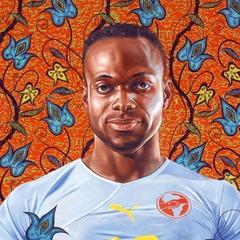
“What came out of that was an intense obsession with status anxiety. So much of these portraits are about fashioning oneself into the image of perfection that ruled the day in the 18th and 19th centuries. It's an antiquated language, but I think we've inherited that language and have forwarded it to its most useful points in the 21st century.”

“I think that once you're able to sort of get in line with who and how you relate to the world, you'll become closer to this index that I'm referring to. Because what you want is this card that relates to that book. What you want is this human that relates to this world, rather than having this art school society scattering that point of view somewhere in between. It becomes diffused. And that level of clarity, I think, was gained at the Studio Museum in Harlem.”

“I had no idea about where I was going. I had no sense of art as anything other than a problem to be fixed, you know, an itch to be scratched. I was in that studio trying my best to feel content with myself. I had, like, a stipend. I had a place to sleep. I had a studio to work in. I had nothing else to think about, you know. And that's - that was a huge luxury in New York City.”

“That's what I think my job in the world has been, is to sort of try to sit silently a bit and watch it all sort of move and see those small, quiet details, whether it be a small village outside of Colombo [country?] or the favelas of Brazil, where, again, resistance culture is something that you hear resonating in the streets of South Central Los Angeles as well.”

“I think that at its best, painting can be an act of juggling perceptions, a hall of mirrors. And it can be a bit confusing and scattering. But as the artist, as the man behind the velvet rope who controls the smoke and the mirrors and the way that things move in the painted space, what I want to do is to try my best to be a good witness.”

“I think didactic art is boring. I mean, I love it in terms of, like, some of the historical precedents that I've learned from. You needed that. We needed those building blocks in terms of - you know, when I look at a great Barbara Kruger, for example, and you're thinking about, you know, the woman's position in society - you know, she found a way of making it beautiful, but at the same time it's very sort of preachy, you know what I mean?”

“For example, in one of my last exhibitions I had a 50-foot massive painting with I think perhaps a hundred thousand hand-painted small flowers. This was the Christ painting [The Dead Christ in the Tomb, 2008] in my Down exhibition [2008]. Now, I simply can't spend eight hours a day painting small, identical flowers. And so I've got a team that allows me to have these grand, sweeping statements.”

“I think what's really interesting and useful about this question is that ultimately all art is a type of self-portraiture. And so in the act of identifying yourself, you're using others to get to that point. And so you're parsing out different aspects of different people in the world. You're choosing not only from America but increasingly globally different aspects of what's out there.”