Quotessence
Home / Authors / Kehinde Wiley
Kehinde Wiley

Kehinde Wiley Quotes

Painter

Filter quotes by topic

Famous Kehinde Wiley Quotes

“I think, at the L.A. County Museum of Art, I saw my first example of Kerry James Marshall, who had a very sort of heroic, oversized painting of black men in a barbershop. But it was painted on the same level and with the same urgency that you would see in a grand-scale [Anthony] van Dyck or [Diego] Velazquez. The composition was classically informed; the painting technique was masterful. And it was something that really inspired me because, you know, these were images of young, black men in painting on the museum walls of one of the more sanctified and sacred institutions in Los Angeles.”

“It became a question of taste. I have a certain taste in art history. And that - I had a huge library of art history books in my studio. And I would simply have the models go through those books with me, and we began a conversation about, like, what painting means, why we do it, why people care about it why or how it can mean or make sense today.”

“I was trying. I was crawling. I was coming into myself. I was trying to in some ways get beyond - what is the word that I'm looking for? - metaphorical language in painting, and to create something that was more indexical. And what I mean by that is that when you go to the library there's an index card that refers to a book that's actual and real in the world. So that index relates to something real.”

“I think that at its best, painting can be an act of juggling perceptions, a hall of mirrors. And it can be a bit confusing and scattering. But as the artist, as the man behind the velvet rope who controls the smoke and the mirrors and the way that things move in the painted space, what I want to do is to try my best to be a good witness.”

“For example, in one of my last exhibitions I had a 50-foot massive painting with I think perhaps a hundred thousand hand-painted small flowers. This was the Christ painting [The Dead Christ in the Tomb, 2008] in my Down exhibition [2008]. Now, I simply can't spend eight hours a day painting small, identical flowers. And so I've got a team that allows me to have these grand, sweeping statements.”

“While it may seem a little mundane, the material realities of realizing the painting actually have a lot to do with how you should read the painting. For example, we assume that what the model is wearing is what we found him in in the streets. No; in fact, a lot of what happens is that in Photoshop certain aspects are being heightened or diminished. There is no actual material truth in these paintings.”

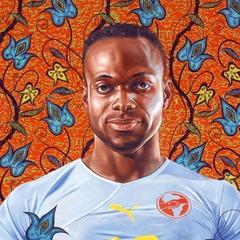
“So much of my work is defined by the difference between the figure in the foreground and the background. Very early in my career, I asked myself, "What is that difference?" I started looking at the way that a figure in the foreground works in eighteenth- and nineteenth-century European paintings and saw how much has to do with what the figure owns or possesses. I wanted to break away from that sense in which there's the house, the wife, and the cattle, all depicted in equal measure behind the sitter.”

“When we talk about Orientalist painting, we're talking about painting generally from the seventeenth through the nineteenth century, and some would say even into the twentieth, that allows Europe to look at Africa, Asia Minor, or East Asia in a way that's revelatory but also as a place in which you can empty yourself out. A place in which there is no place. It's an emptiness and a location at once.”

“Let's talk about the artist's desire to go beyond the pictorial or the representational and the desire to create the abstract - the idea that painting can go beyond what is seen. What we found is that, increasingly, painting became about paint, its own material truth. When I'm talking about the way that we look at others and the way that we see ourselves increasingly, looking at others becomes its own material truth.”

“I happen to be a twin. I grew up half of my life with someone who looks and sounds like me. And I believe it's possible to hold twin desires in your head, such as the desire to create painting and destroy painting at once. The desire to look at a black American culture as underserved, in need of representation, a desire to mine that said culture and to lay its parts bare and look at it almost clinically.”